
 Mexico
Aqueduct of Padre Tembleque Hydraulic System
This 16th century aqueduct is located between the states of Mexico and Hidalgo, on the Central Mexican Plateau.
Aqueduct of Padre Tembleque Hydraulic System
🏛️ Overview & Historical Significance
Inscribed as a UNESCO World Heritage site in 2015, the Aqueduct of Padre Tembleque Hydraulic System (Sistema Hidráulico del Acueducto del Padre Tembleque) stands as one of the most extraordinary civil engineering accomplishments of the Renaissance era in the Americas. Spanning 45 kilometers (28 miles) across the high plateau of Central Mexico—straddling the state border between Hidalgo and the State of Mexico—this monument represents a brilliant synthesis of European hydraulic technology and traditional Mesoamerican construction expertise.
Conceived between 1553 and 1570 by the Franciscan friar Francisco de Tembleque, the system was designed to convey fresh spring water from the slopes of the Tecajete volcano near Zempoala to the water-scarce indigenous communities of Otumba. What makes this infrastructure uniquely historic is its transcultural execution: Friar Tembleque collaborated with local Otomí and Nahua master craftsmen and laborers, who utilized indigenous adobe architecture, unworked basaltic rock, and traditional lime mortar mixed with cactus juice (nopal mucilage) to create a monument capable of standing firm for nearly five centuries.
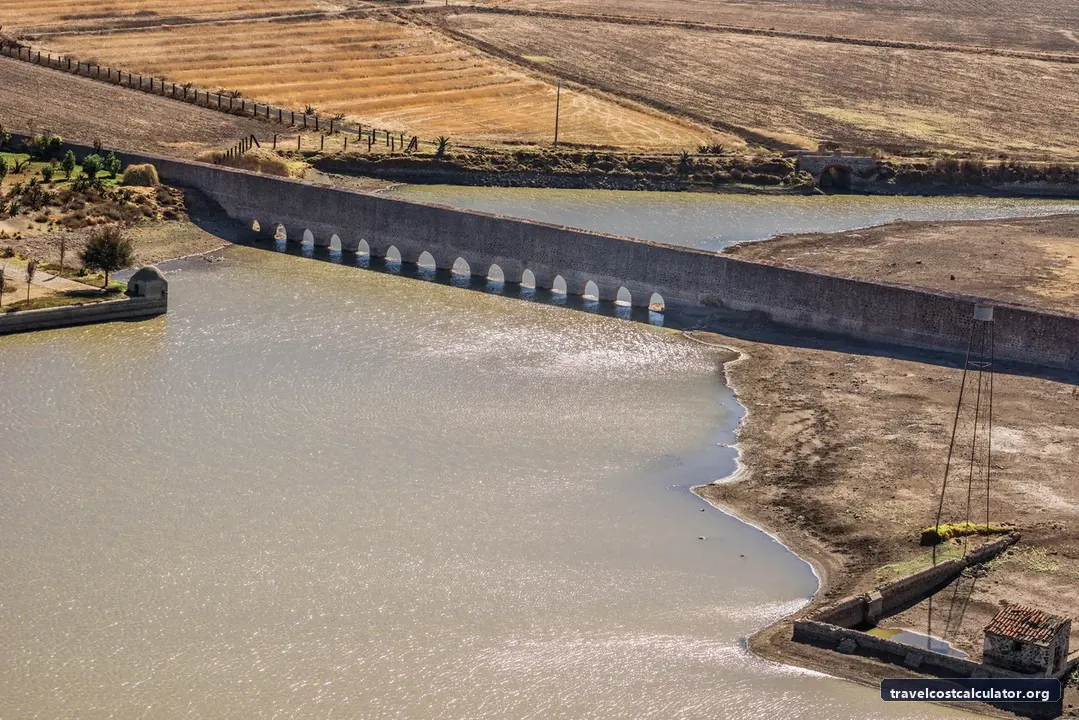
The masterpiece of the entire 45-kilometer system is the famous Arquería Mayor (Main Arcade), located in the Papalote River valley near the village of Santiago Travel Budget Tepeyahualco. This magnificent stretch contains 68 soaring arches. Its central arch rises to an impressive height of 38.75 meters (127 feet) with a span of 17 meters, making it the highest single-tier arcade arch built during the 16th century anywhere in the world. UNESCO awarded the site World Heritage status because it exemplifies a masterwork of human creative genius and an exceptional exchange of human values, merging European Roman aqueduct tradition with pre-Hispanic architectural techniques.
🎟️ Entrance Fees, Opening Hours & Ticket Booking Tips
Visiting the Aqueduct of Padre Tembleque remains an authentic, un-commercialized open-air experience. Because the hydraulic system spans wide countryside fields and deep ravines, it operates without formal turnstiles or corporate ticketing platforms.
-
✦
Site Entrance Fee: Free ($0 USD / $0 MXN). Access to view, walk along, and photograph the Aqueduct of Padre Tembleque and its main arches is completely open to the public.
-
✦
Vehicle Parking Fee: ~50 MXN ($2.50 USD) paid directly to local Ejido (community land committee) attendants at the designated parking area near the Arquería Mayor.
-
✦
Local Community Guide Fee (Optional): ~150–300 MXN ($8.00–$15.00 USD) for a 45-minute guided walking tour led by local ejidatarios. Hiring a local guide is highly recommended as it provides rich historical context while supporting the local rural economy.
-
✦
Operating Hours: The open-air site is physically accessible 24/7. However, official visitor facilities, local guide stands, and food stalls operate strictly from 8:00 AM to 5:30 PM daily. For personal safety and optimal lighting, plan to complete your visit well before dusk.
-
✦
Booking Tips: Advance tickets are not required. Ensure you carry physical cash in Mexican Pesos (MXN) in small denominations (20, 50, and 100 MXN notes), as credit card readers rarely have reliable cellular signal in this rural valley.
🚌 How to Get There & Local Transit Costs
The main viewing zone for the aqueduct (Arquería Mayor) is located near Santiago Tepeyahualco, accessible from either Mexico City Travel Budget (CDMX) (approx. 85 km / 53 miles away) or Pachuca (approx. 50 km / 31 miles away).
Option A: By Rental Car or Private Transport (Most Convenient)
Driving provides the greatest flexibility to explore both the main arcade and the historic towns of Otumba and Zempoala.
-
✦
From Mexico City: Take Highway 132D (Mexico-Pachuca motorway) towards Pirámides/Tulancingo, exiting toward Otumba / Sahagún on Highway 115. Follow signs to Santiago Tepeyahualco. Drive time is approximately 1 hour and 20 minutes. Toll costs average 120–150 MXN ($6.00–$7.50 USD) each way.
-
✦
Daily Rental Car Cost: Expect to pay between $35.00 and $60.00 USD (700–1,200 MXN) per day for a standard vehicle rental in Mexico City or CDMX airport, plus fuel.
Option B: By Public Bus & Local Taxi/Colectivo
Budget travelers can easily reach the site via public transit from Mexico City's northern bus terminal:
-
✦
Step 1: Go to Terminal Central de Autobuses del Norte in Mexico City. Board an intercity bus bound for Otumba or Ciudad Sahagún (operated by lines like Autobuses Teotihuacanos or Flecha Roja). One-way ticket: 110–140 MXN ($5.50–$7.00 USD); trip duration is roughly 1.5 hours.
-
✦
Step 2: From the Otumba bus terminal, take a local colectivo (shared minibus) heading toward Tepeyahualco (approx. 20 MXN / $1.00 USD) or hire a local taxi directly to the "Arcos de Tembleque" for approximately 120–180 MXN ($6.00–$9.00 USD). Arrange a return pickup time with your taxi driver, as finding a taxi directly at the arches for the return trip can be unpredictable.
📸 Best Photography Spots & Insider Visit Hacks
Capturing the scale of Friar Tembleque’s architectural feat requires knowing where to shoot and how to manage the rural terrain.
Top Photography Vantage Points
-
✦
The Ravine Floor (Base of Central Arch): Walk down into the Papalote Ravine directly beneath the tallest central arch (Arch 50). Looking up from the bottom highlights the staggering 38.75-meter height framing the blue sky. Use a wide-angle lens (16mm–24mm equivalent).
-
✦
Northern Ridge Panorama: Climb the slight elevation on the northern side of the main arcade. From here, you can align the repeating arches leading toward the distant horizon, capturing the true sense of length across the high-altitude landscape.
-
✦
The Historic Water Conduit (Top Section): Nearby preserved sections show the original stone water channel where spring water once flowed.
Insider Visit Hacks
-
✦
Optimal Time of Day: Golden Hour—between 3:30 PM and 5:15 PM—is prime for photography. The setting sun casts a warm, honey-gold glow against the red volcanic stone and lime mortar.
-
✦
Best Season: October through April offers dry, clear skies and mild temperatures. July and August bring lush green landscapes, but heavy afternoon rain showers can make the dirt paths inside the ravine muddy and slippery.
-
✦
Sun Protection & Gear: The site sits at an elevation of over 2,200 meters (7,200 feet). The UV index is exceptionally high, and there is almost no natural shade near the arches. Bring high-SPF sunblock, a wide-brimmed hat, sturdy walking shoes for uneven dirt trails, and at least 1.5 liters of drinking water per person.
-
✦
Combine with Local Pulque Culture: The surrounding region of Zempoala is world-renowned for its historic haciendas pulqueras. After visiting the arches, stop at a local hacienda to sample pulque (a traditional fermented agave beverage known as the "drink of the gods").
🏨 Nearby Accommodation & Daily Budget Allocation
While the Aqueduct of Padre Tembleque can easily be visited as a day trip from Mexico City or Pachuca, staying overnight in nearby colonial towns like San Juan Teotihuacan, Otumba, or Zempoala offers a richer regional experience.
Accommodation Options
-
✦
Budget Stay (Otumba / Zempoala Town): Local family-run guesthouses and modest hotels. Clean room with basic amenities: $25.00–$45.00 USD (500–900 MXN) per night.
-
✦
Mid-Range Option (San Juan Teotihuacan / Pachuca): Boutique colonial hotels or cozy inns located near the Teotihuacan archaeological zone or Pachuca center: $65.00–$120.00 USD (1,300–2,400 MXN) per night.
-
✦
Luxury / Historic Hacienda Stay: Restored 16th to 19th-century pulque estates (e.g., Hotel Hacienda Zempoala or nearby boutique haciendas) offering historic luxury, gardens, and gourmet regional dining: $160.00–$300.00 USD (3,200–6,000 MXN) per night.
Estimated Daily Travel Budget Allocation (Per Person, 2026)
-
✦
Backpacker Budget Planner: $35.00–$50.00 USD / day (Public transit from CDMX, street food/regional comida corrida, free site admission, budget guesthouse share).
-
✦
Mid-Range Traveler Budget: $90.00–$160.00 USD / day (Rental car share/tolls, mid-range boutique hotel, sit-down restaurant dining, hiring a local site guide).
-
✦
Luxury / Private Heritage Budget: $250.00+ USD / day (Private chauffeur transport, historic hacienda accommodation, fine dining, private historian tour guide).
Frequently Asked Questions
Essential visitor FAQs for Aqueduct of Padre Tembleque Hydraulic System
What is the entrance fee for Aqueduct of Padre Tembleque Hydraulic System?
How much time do you need to explore Aqueduct of Padre Tembleque Hydraulic System?
How do I get to Aqueduct of Padre Tembleque Hydraulic System from the nearest city?
📊 Heritage Quick Specs
Visiting Mexico on a Budget?
Calculate your full daily travel budget for Mexico — including hotel costs, local transport, food, and sightseeing expenses.
View Mexico Daily Travel Costs →Explore more UNESCO World Heritage Sites
🏛️ All 1,200+ Heritage Sites →