
 Israel
White City of Tel-Aviv – the Modern Movement
Tel Aviv was founded in 1909 and developed as a metropolitan city under the British Mandate in Palestine.
White City of Tel-Aviv – the Modern Movement
🏛️ Overview & Historical Significance
In 2003, UNESCO designated the White City of Tel-Aviv – the Modern Movement as a World Heritage site, recognizing it as an outstanding synthesis of early 20th-century architectural trends adapted to a distinct local climate and cultural context. Constructed primarily between 1930 and 1948, the White City represents the world's largest concentration of Bauhaus and International Style architecture, encompassing over 4,000 preserved structures spread across the historic core of Tel Aviv Travel Budget.
The origin of this urban marvel stems from a pivotal moment in global history. During the 1930s, German-Jewish architects who studied at the revolutionary Bauhaus school in Weimar, Dessau, and Berlin—as well as master architects trained in Paris, Vienna Travel Budget, and Warsaw Travel Budget—fled rising Nazi persecution and immigrated to Mandatory Palestine. Figures such as Arieh Sharon, Dov Karmi, Genia Averbuch, and Shmuel Mestechkin brought European Modernism to the Mediterranean coast, where they encountered the urban plan drawn by Scottish town planner Sir Patrick Geddes in 1925. Geddes had envisioned a "garden city" featuring tree-lined green boulevards, internal public courtyards, and quiet residential blocks.
To succeed in the blistering Middle Eastern climate, these pioneering architects adapted classical Bauhaus principles of functionality and clean geometry into a unique local variant:
-
✦
Climate-Responsive Openings: The wide glass curtain walls favored in icy European winters were replaced with long, narrow vertical ribbon windows ("thermometer windows") and deeply recessed horizontal balconies designed to block direct sun while capturing sea breezes.
-
✦
Pilotis (Stilts): Buildings were elevated on concrete columns, raising ground-floor apartments above street dust and allowing air to circulate freely underneath the structure.
-
✦
Flat Roofs & Reflective Plaster: Slanted roofs were discarded in favor of flat roofs meant for communal gatherings, drying laundry, or urban gardens. Facades were rendered in light white, off-white, or sand-colored silicate plaster to reflect intense solar radiation.
Today, visiting Tel Aviv’s White City offers an immersive look into an open-air architectural canvas where historic preservation meets vibrant 2026 Mediterranean urban life.
🎟️ Entrance Fees, Opening Hours & Ticket Booking Tips
Because the White City of Tel-Aviv is an entire living urban district, **exploring the street-level architecture is 100% free of charge 24/7**. However, to fully understand the engineering, social history, and design nuances of the area, visiting dedicated cultural centers and taking guided walking tours is highly recommended.
Key Visitor Hubs & Museum Ticket Prices (Estimated 2026 Fares)
-
✦
Liebling Haus – White City Center (29 Idelson St): The flagship research and exhibition center housed in an authentic 1937 International Style residence designed by Dov Karmi.
- Entrance Fee: Free general admission to permanent spaces; 25 ILS – 35 ILS ($7 – $10 USD) for special curated exhibitions and workshop entry.
-
✦
Opening Hours: Tuesday to Thursday (09:00 – 19:00), Friday (09:00 – 14:00), Saturday (10:00 – 14:00). Closed Sundays and Mondays.
- Self-Guided Audio Tour: 50 ILS (~$13.50 USD) (Includes audio headset rental and detailed map; available in English, German, French, Hebrew, and Russian).
- Entrance Fee: 25 ILS (~$7 USD) per person.
Insider Ticket Booking Hacks
During the peak spring travel months, guided architectural walks book out quickly. Reserve your tour online at least 5 to 7 days in advance via the official Bauhaus Center or Liebling Haus portals. If you are traveling on a strict budget, download the free self-guided GPS audio walking routes available on the Liebling Haus website, which highlight key architectural details along Rothschild Boulevard and Idelson Street.
🚌 How to Get There & Local Transit Costs
The White City occupies the heart of central Tel Aviv, centered around Rothschild Boulevard, Bialik Street, Dizengoff Square, and Sheinkin Street. Transit connection options are streamlined across the city.
Arriving from Ben Gurion International Airport (TLV)
The fastest mode of transport into central Tel Aviv is by direct train operated by Israel Railways:
-
✦
Take the train from Airport Terminal 3 to Tel Aviv HaShalom Station or Tel Aviv Savidor Central.
-
✦
Travel Time: 18 – 22 minutes.
-
✦
Fare: 15 ILS – 18 ILS (~$4.10 – $4.90 USD) one-way.
Local City Transit Fares & Payment Methods (2026 Pricing)
Tel Aviv public transportation operates via a unified contactless payment system using either a smart card called a Rav-Kav or mobile ticketing apps (such as Moovit or HopOn). Cash is not accepted onboard buses or light rail trains.
-
✦
Dankal Light Rail (Red Line): The light rail serves key stops near the White City edge (e.g., Allenby Station or Yehudit Station). Single urban fare costs 6.00 ILS – 8.00 ILS (~$1.65 – $2.20 USD).
-
✦
Dan & Egged City Buses: Bus lines #4, #5, #14, and #25 run direct routes along Dizengoff Street, Rothschild Boulevard, and Allenby Street. Fares start at 6.00 ILS ($1.65 USD) for a single 90-minute transfer window.
-
✦
Taxis & Ride-Hailing (Gett App): A short ride within central Tel Aviv costs between 35 ILS and 65 ILS (~$9.50 – $17.50 USD), depending on daytime vs. nighttime tariffs.
-
✦
Micromobility (E-Scooters & Bikes): Shared bike networks (Tel-O-Fun) and e-scooters (Lime, Bird, Dott) line Rothschild Boulevard's dedicated bike highway. Unlocking costs ~5 ILS ($1.35 USD) plus 0.80 ILS ($0.22 USD) per minute.
Important Shabbat Note: Regular public buses and trains cease operations from Friday afternoon (approx. 3:00 PM) through Saturday evening (after sunset). However, shared weekend minibuses (known as Na'im BeShabbat) operate along main routes free of charge, and e-scooters or taxis remain fully functional.
📸 Best Photography Spots & Insider Visit Hacks
Top 5 Photogenic Landmarks
-
✦
The Engel House (84 Rothschild Blvd): Designed by Dov Karmi in 1933, this landmark is famous as the first Tel Aviv structure built on ground-elevating pilotis columns. Shoot from across the green pedestrian boulevard to frame the stilts with palm foliage.
-
✦
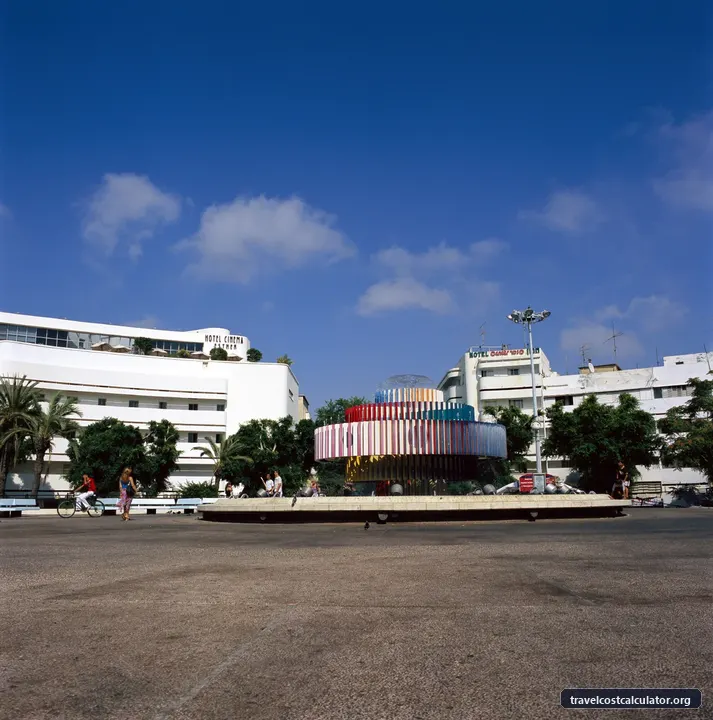
Dizengoff Square: Redesigned by Genia Averbuch in 1934, this plaza features sweeping curved white balconies encircling Yaacov Agam’s colorful Fire and Water Fountain. The circular design illustrates pure functionalism.
-
✦
Liebling Haus Rooftop (29 Idelson St): Head to the top deck for elevated photos over surrounding modern residential rooftops, leafy internal courtyards, and clean-lined balconies.
-
✦
Bialik Street & Square: A picturesque street anchored by the historic municipal building (Bialik 27) and flanked by restored 1930s homes including the classic Bauhaus Museum and Cafe Bialik.
-
✦
The Thermometer Window at 9 Montefiore St: Capture the dramatic, elongated vertical glass shaft that illuminates the internal staircase—a signature adaptation designed to let in light while avoiding heat glare.
Ideal Lighting & Seasonal Weather
The optimal lighting window for photographing the White City facades occurs during early morning (07:00 AM – 09:30 AM). At dawn, the low-angled sun casts dramatic sharp shadows across the geometric balconies, and the street corridors are devoid of heavy traffic and delivery vehicles. Golden Hour (16:30 PM – 18:00 PM) gives the off-white plaster facades a warm, sun-kissed glow.
The best seasons to visit are Spring (April to May) and Autumn (September to November) when temperatures average a comfortable 22°C – 27°C (72°F – 80°F). July and August bring intense heat (>32°C / 90°F) paired with extreme humidity, making extended architectural walking tours challenging.
🏨 Nearby Accommodation & Daily Budget Allocation
Tel Aviv is one of the Middle East's most modern destinations, and accommodation prices reflect its high demand. Staying inside or adjacent to the UNESCO zone allows you to walk to all key architectural landmarks, cafes, and Mediterranean beaches within 10 to 15 minutes.
Recommended Accommodations Near the White City
-
✦
Budget Option – Abraham Hostel Tel Aviv (21 Levontin St): Located a 5-minute walk from Rothschild Boulevard. Features vibrant communal spaces, organized tours, and social events.
- Estimated 2026 Rates: Dorm beds from $35 – $55 USD (130 – 200 ILS); private rooms from $120 – $165 USD (440 – 610 ILS) per night.
- Estimated 2026 Rates: $180 – $275 USD (660 – 1,010 ILS) per night including breakfast.
- Estimated 2026 Rates: $550 – $950+ USD (2,030 – 3,500+ ILS) per night.
Daily Travel Budget Estimations (2026)
To help you allocate your travel funds effectively, consider the three daily spending profiles below:
| Budget Tier | Daily Budget (USD) | Daily Budget (ILS) | Includes |
|---|---|---|---|
| Backpacker | $75 – $110 | 280 – 400 ILS | Hostel dorm, street food (falafel/sabich 25–35 ILS), self-guided walk, public transit. |
| Mid-Range Traveler | $220 – $360 | 810 – 1,330 ILS | 3-star/Boutique Bauhaus hotel, cafe breakfasts, guided walking tour, casual sit-down dinners. |
| Luxury Traveler | $650+ | 2,400+ ILS | 5-star historic hotel, private taxi rides, private architectural guide, fine dining & cocktails. |
Frequently Asked Questions
Essential visitor FAQs for White City of Tel-Aviv – the Modern Movement
What is the entrance fee for White City of Tel-Aviv – the Modern Movement?
How much time do you need to explore White City of Tel-Aviv – the Modern Movement?
How do I get to White City of Tel-Aviv – the Modern Movement from the nearest city?
📊 Heritage Quick Specs
Visiting Israel on a Budget?
Calculate your full daily travel budget for Israel — including hotel costs, local transport, food, and sightseeing expenses.
View Israel Daily Travel Costs →Explore more UNESCO World Heritage Sites
🏛️ All 1,200+ Heritage Sites →