
 India
Agra Fort
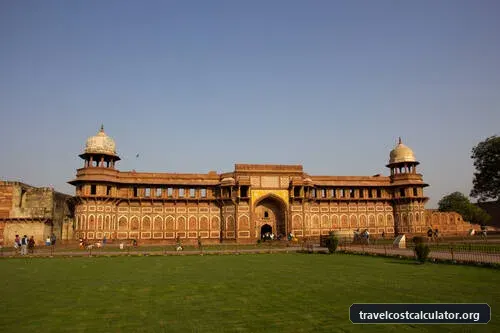
Near the gardens of the Taj Mahal stands the important 16th-century Mughal monument known as the Red Fort of Agra.
Agra Fort
🏛️ Overview & Historical Significance
Inscribed as a UNESCO World Heritage site in 1983, Agra Fort (often called the Red Fort of Agra) stands as one of the world's most formidable architectural masterpieces. Located on the banks of the Yamuna River in Uttar Pradesh, India, this massive red sandstone fortress served as the primary imperial residence of the main emperors of the Mughal Dynasty—Akbar, Jahangir, Shah Jahan, and Aurangzeb—until the Mughal capital officially shifted to Delhi in 1638.
Originally a ruined brick fort known as Badalgarh held by Hindu Sikarwar Rajputs, the site was reclaimed and entirely rebuilt in red sandstone by Emperor Akbar the Great beginning in 1565. Over 4,000 builders worked for eight years to complete its towering 70-foot-high double-walled fortifications spanning a perimeter of 2.5 kilometers (1.5 miles). While Akbar constructed the outer walls and early palaces in rich red sandstone, his grandson Shah Jahan later transformed the interior, adding brilliant white marble palaces adorned with intricate pietra dura (stone inlay work).
UNESCO recognized Agra Fort for its unparalleled historical importance, architectural fusion of Persian and Hindu motifs, and its role as the administrative heart of the Mughal Empire during its golden age. Key architectural highlights within the complex include:
-
✦
Jahangiri Mahal: Built by Akbar for his son Jahangir, this multi-story palace blends Islamic geometry with traditional Rajasthani architectural elements, featuring ornate stone brackets and intricate carved lattice screens (jalis).
-
✦
Diwan-i-Am (Hall of Public Audience): A majestic assembly hall featuring 84 double curved arches crafted from plaster-coated red sandstone, where the Emperor sat on an elevated marble balcony (the Takht-i-Nishin) to hear grievances from the public.
-
✦
Diwan-i-Khas (Hall of Private Audience): Built by Shah Jahan in 1635, this white marble pavilion was reserved for receiving foreign ambassadors and high-ranking dignitaries. It once housed the legendary Peacock Throne before it was removed to Delhi.
-
✦
Musamman Burj: An octagonal white marble tower with a sweeping balcony that offers direct views across the Yamuna River to the Taj Mahal. Tragically, this is where Shah Jahan was imprisoned by his ambitious son Aurangzeb for the final eight years of his life, gazing out at his beloved wife’s tomb until his death in 1666.
-
✦
Sheesh Mahal (Palace of Mirrors): Designed as a royal dressing room, its walls and ceilings are inlaid with thousands of tiny, imported Syrian glass mirrors that reflect candlelight into shimmering constellations.
🎟️ Entrance Fees, Opening Hours & Ticket Booking Tips
Visiting Agra Fort requires navigating a dual-component fee system managed jointly by the Archaeological Survey of India (ASI) and the Agra Development Authority (ADA). Entry prices are updated for 2026 to encourage cashless, digital ticketing.
2026 Ticket Pricing Breakdown
-
✦
Foreign Tourists: ₹650 INR (~$7.60 USD) for offline paper tickets at the box office. If purchased online via the official ASI portal, the discounted fare is ₹600 INR (~$7.00 USD).
-
✦
SAARC & BIMSTEC Country Citizens: ₹550 INR (~$6.45 USD) offline / ₹500 INR (~$5.85 USD) online.
-
✦
Indian Citizens & OCI Cardholders: ₹50 INR (~$0.60 USD) offline / ₹35 INR (~$0.40 USD) online.
-
✦
Children (Under 15 years old of any nationality): Free entry (valid passport or ID required at entry gates).
Crucial Ticket Booking & Money-Saving Hacks
1. The Taj Mahal Combination Ticket Discount: If you visit the Taj Mahal on the exact same day prior to visiting Agra Fort, keep your physical or digital Taj Mahal ticket voucher. You can present it at the Agra Fort ticket counter or select the "ADA Exemption" option online to skip paying the ₹100 ADA toll component again, effectively saving ₹50–₹100 INR on your fort ticket.
2. Advance Digital Booking: Avoid standing in 45-minute ticket queues under the sun at the Amar Singh Gate. Book tickets directly at the official ASI site (pay.asi.gov.in). Digital tickets include a fast-track QR code scanned directly at the turnstiles.
3. Operating Hours: Agra Fort is open 7 days a week from 30 minutes before sunrise to 30 minutes after sunset (roughly 6:00 AM to 6:30 PM). Unlike the Taj Mahal, which is closed on Fridays, Agra Fort remains open every day of the year.
4. Sound & Light Show (Evening): An evening Son et Lumière show takes place after dusk near the Diwan-i-Am. Tickets cost ₹300 INR (~$3.50 USD) for the Hindi show and ₹500 INR (~$5.85 USD) for the English show. Tickets can be bought at the fort ticket window starting at 5:00 PM.
🚌 How to Get There & Local Transit Costs
Agra Fort sits approximately 200 kilometers (125 miles) south of New Delhi Travel Budget and roughly 2.5 kilometers northwest of the Taj Mahal. Most international travelers reach Agra via Delhi using India's high-speed rail network or the Yamuna Expressway.
1. From Delhi to Agra (Intercity Transit)
-
✦
High-Speed Train (Recommended): The Gatimaan Express (Train #12050) departs Delhi’s Hazrat Nizamuddin Station daily (except Fridays) at 8:10 AM, arriving at Agra Cantt (AGC) in just 1 hour and 40 minutes. 2026 Fares: Executive Chair Car (EC) costs approx. ₹1,650 INR (~$19.50 USD); AC Chair Car (CC) costs ₹850 INR (~$10.00 USD) including breakfast. Alternatively, the daily Vande Bharat Express offers similar speed and comfort.
-
✦
Private Taxi / Express Highway: Driving via the Yamuna Expressway takes approximately 3 to 3.5 hours. A private one-way AC sedan taxi from Delhi Airport (DEL) or downtown Delhi to Agra costs between ₹3,500 INR and ₹4,500 INR ($41 – $53 USD), including toll charges.
-
✦
Express Buses: Air-conditioned Volvo buses depart frequently from Delhi's Sarai Kale Khan and ISBT Kashmiri Gate terminals to Agra's ISBT. Fares range from ₹400 INR to ₹750 INR ($4.70 – $8.80 USD) one-way.
2. From Agra City Hubs to Agra Fort
-
✦
Agra Metro (2026 Transit Upgrade): The Agra Metro Priority Corridor directly connects the Taj Mahal East Gate, Agra Fort Station, and Agra Cantt Station. Trains run every 7 minutes. A single-ride token between major stops costs between ₹10 INR and ₹30 INR ($0.12 – $0.35 USD), making it the fastest and cheapest option.
-
✦
Auto-Rickshaws (Tuk-Tuks): A ride from Agra Cantt Railway Station to Agra Fort costs between ₹150 INR and ₹250 INR ($1.75 – $2.95 USD) after negotiating. A short auto-rickshaw ride between the Taj Mahal and Agra Fort costs roughly ₹100 INR to ₹150 INR ($1.20 – $1.75 USD).
-
✦
App-Based Rideshares (Uber / Ola): Uber and Ola operate extensively in Agra. An Uber Go ride from Agra Cantt station to the fort entry gate costs around ₹160 INR to ₹220 INR ($1.90 – $2.60 USD).
📸 Best Photography Spots & Insider Visit Hacks
Top 4 Photography Vantage Points
1. Musamman Burj Balcony: Frame the distant, glowing white dome of the Taj Mahal across the Yamuna River through the marble arches. Use a telephoto lens (85mm–200mm) to compress the distance for dramatic architectural shots.
2. Diwan-i-Am Pillared Hall: Stand at the side angles of the Hall of Public Audience during mid-morning to capture symmetrical rows of red sandstone arches illuminated by soft side-lighting.
3. Jahangiri Mahal Courtyard: Photograph the dramatic geometric carved brackets and central courtyard. Look up toward the roofline to capture the contrast between deep red sandstone and brilliant blue skies.
4. Anguri Bagh (Grape Garden): Position yourself at the center of the sunken geometrically patterned garden, pointing your camera toward the pristine white marble façade of the Khas Mahal.
Insider Hacks & Pro Tips
-
✦
Ideal Season to Visit: The best weather window is from October through March, when daily temperatures range between a pleasant 12°C and 25°C (53°F – 77°F). Avoid May and June, when temperatures routinely exceed 42°C (107°F).
-
✦
Avoiding Crowds & Fog: Arrive at the gates by 6:30 AM – 7:00 AM right as entry opens. You will enjoy 90 minutes of peaceful exploration before large tour buses arrive around 9:00 AM. Note: In December and January, morning river fog can temporarily obscure views of the Taj Mahal from Musamman Burj; late afternoon visits (3:30 PM – 5:30 PM) offer clearer air and golden-hour light.
-
✦
Hiring Licensed Guides: Only hire official ASI-approved guides carrying valid photo ID badges around the Amar Singh Gate. Standard 2026 rates for an authorized guide range from ₹500 INR to ₹800 INR ($5.85 – $9.40 USD) for a 2-hour tour. Ignore unofficial street touts offering cheap entry tricks.
-
✦
Strict Security Restrictions: Security checks at Amar Singh Gate are rigorous. Small daypacks, cell phones, water bottles, and cameras are allowed. Prohibited items include: tripods, monopods, drone equipment, power banks, large backpacks, tobacco, lighters, weapons, and food items. Left-luggage lockers are available at the entry plaza for ₹50 INR per bag.
🏨 Nearby Accommodation & Daily Budget Allocation
Recommended Stays Near Agra Fort
-
✦
Budget Hostels ($10 – $25 USD / night): The Hosteller Agra or Zostel Agra. Located in the Taj Ganj area (10 minutes by rickshaw), offering clean dorm beds, private rooms, rooftop cafes with fort/Taj views, and fast Wi-Fi.
-
✦
Mid-Range Hotels ($45 – $100 USD / night): Howard Plaza The Fern or Crystal Sarovar Premiere. Featuring comfortable AC rooms, swimming pools, multiple dining options, and close proximity to both Agra Fort and the Taj Mahal.
-
✦
Luxury Heritage & Resorts ($300 – $750+ USD / night): The Oberoi Amarvilas or ITC Mughal, a Luxury Collection Hotel. Offers opulent Mughal-inspired architecture, lush gardens, butler services, and direct views of imperial monuments.
Local Dining Highlights
Don't leave Agra without trying local delicacies like Agra Petha (a traditional candied translucent pumpkin dessert sold at authentic Panchhi Petha stores) and savory Bedai with Aloo Sabzi (crispy fried lentils bread served with spicy potato curry, traditional for breakfast). For sitting meals, Pinch of Spice (mid-range Indian dining) and Shankara Veg Roof Garden (budget-friendly vegetarian rooftop) are top choices.
2026 Daily Budget Allocation Breakdown (Per Person)
To help you budget accurately for your trip to Agra, here are realistic estimated daily expenditure tiers incorporating entry fees, local transport, meals, and lodging:
-
✦
Backpacker / Budget Tier: $25 – $40 USD / day (₹2,100 – ₹3,400 INR)
- Lodging: Hostel dorm or budget guesthouse ($10–$15)
-
✦
Food: Street food & local vegetarian thalis ($8–$12)
-
✦
Transit: Agra Metro, shared autos, standard train tickets ($4–$6)
-
✦
Attractions: Agra Fort entry with online discount ($7)
- Lodging: 3/4-star modern hotel with breakfast ($50–$90)
- Lodging: 5-star luxury resort like Oberoi Amarvilas ($350–$700)
Frequently Asked Questions
Essential visitor FAQs for Agra Fort
What is the entrance fee for Agra Fort in 2026?
How much time do you need to explore Agra Fort?
How do I get to Agra Fort from the nearest city (New Delhi)?
📊 Heritage Quick Specs
Visiting India on a Budget?
Calculate your full daily travel budget for India — including hotel costs, local transport, food, and sightseeing expenses.
View India Daily Travel Costs →Explore more UNESCO World Heritage Sites
🏛️ All 1,200+ Heritage Sites →