
 Egypt
Wadi Al-Hitan (Whale Valley)
Wadi Al-Hitan, Whale Valley, in the Western Desert of Egypt, contains invaluable fossil remains of the earliest, and now extinct, suborder of whales, Archaeoceti.
Wadi Al-Hitan (Whale Valley)
1. 🏛️ Overview & Historical Significance
Deep within the windswept expanse of Egypt’s Western Desert, roughly 150 kilometers southwest of Cairo Travel Budget, lies Wadi Al-Hitan (Whale Valley)—one of the world’s most astonishing geological and paleontological treasures. In 2005, UNESCO designated this remote desert valley a World Heritage site due to its unmatched evidence of a crucial turning point in earth's history: the evolution of whales from land-dwelling mammals to ocean-going giants.
Around 40 million years ago, during the Eocene epoch, this arid landscape was covered by the shallow waters of the ancient Tethys Sea. As the sea retreated over geological epochs, wind and water erosion carved away layers of sandstone and limestone rock, exposing thousands of fossilized remains intact. Unlike typical fossil beds, Wadi Al-Hitan features complete skeletons of the earliest sub-order of whales, known as Archaeoceti.
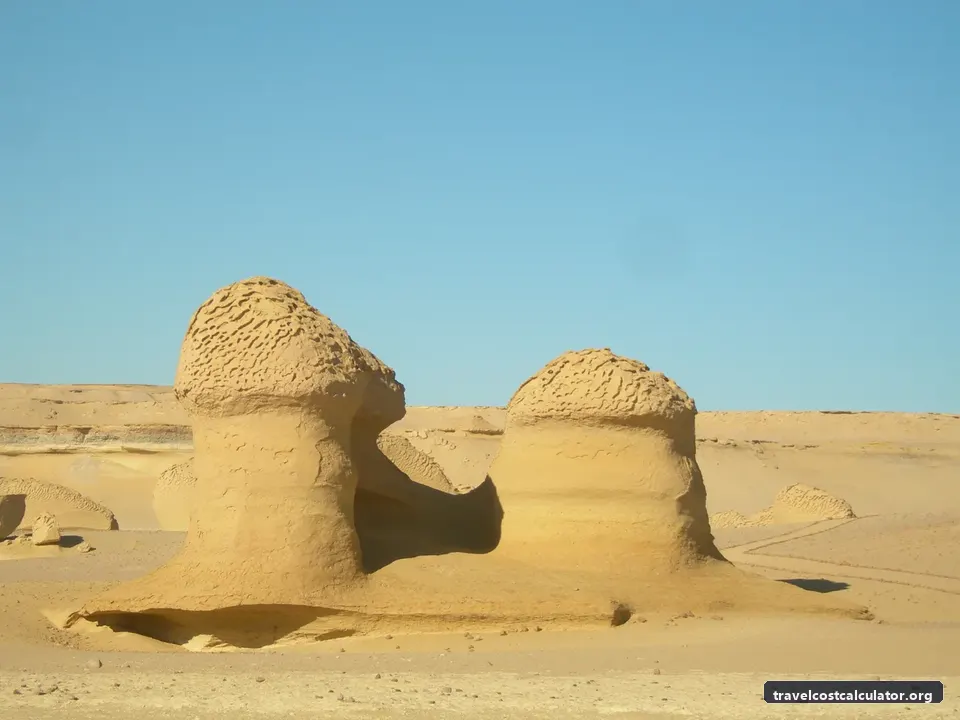
The site's global value rests on the discovery of specimens such as Basilosaurus isis (which grew up to 18 meters in length) and Dorudon atrox. Crucially, these fossils retain vestigial hind limbs, feet, and toes—physical evidence proving that modern cetaceans descended from quadrupedal land mammals that gradually adapted to marine life. Alongside the whales, paleontologists have unearthed fossilized sea cows (sirenians), prehistoric crocodiles, sawfish teeth, sea turtles, and petrified mangrove roots. Today, visitors can explore this open-air museum where ancient skeletons lie preserved in sand dunes framed by dramatic wind-sculpted rock formations known as yardangs.
2. 🎟️ Entrance Fees, Opening Hours & Ticket Booking Tips
Visiting Wadi Al-Hitan involves a two-part fee structure: the entrance ticket to the overall Wadi El-Rayan Protectorate (the nature reserve encompassing the region) and the dedicated site ticket for the Wadi Al-Hitan Fossil Site & Climate Change Museum.
Estimated 2026 Entrance Fees
-
✦
Foreign Adult Combined Ticket: ~500 EGP to 600 EGP (approx. $10.00 – $12.00 USD / €9.50 – €11.00), covering both protectorate entry and the fossil site/museum.
-
✦
Foreign Student Ticket (with valid ISIC card): ~250 EGP to 300 EGP (approx. $5.00 – $6.00 USD).
-
✦
Egyptian Citizens / Residents: ~60 EGP – 100 EGP.
-
✦
Vehicle Protectorate Fee: ~50 EGP – 100 EGP per private vehicle at the main park reserve gate.
-
✦
Tripods & Professional Camera Gear: Standard smartphone photography is free. Professional cameras or commercial tripods may require an additional permit fee of ~100 EGP at the visitor center.
Opening Hours & Logistics
The site is open daily from 7:00 AM to 5:30 PM during summer and from 7:00 AM to 4:30 PM in winter. The on-site Wadi Al-Hitan Climate Change & Fossils Museum operates during these same hours.
Ticket Booking Tips
-
✦
Payment Options: The Egyptian Ministry of Tourism and Antiquities has transitioned most major ticketing booths to electronic card payments (Visa/Mastercard). However, because cellular connectivity can be intermittent in deep desert areas, carry sufficient local currency (EGP cash) as a backup for park gates and local drivers.
-
✦
No Prior Online Reservation Mandatory: Tickets are purchased at the gate upon arrival or arranged as part of an organized desert tour package out of Cairo or Tunis Travel Budget Village.
3. 🚌 How to Get There & Local Transit Costs
Wadi Al-Hitan is located inside the desert core of the Faiyum Governorate. Because there is no public transit directly into the deep desert reserve, transportation requires planning around 4x4 vehicles, private drivers, or tour groups.
Option 1: Guided 4x4 Day Tour from Cairo (Most Popular & Practical)
The most straightforward method for international travelers is booking a private or small-group 4x4 excursion from Cairo. The drive takes approximately 2.5 to 3.5 hours each way via the Cairo-Faiyum Desert Road.
-
✦
Estimated Cost (2026): $130 – $190 USD total per private 4x4 vehicle (fits up to 4 passengers), including driver, fuel, hotel pickup/drop-off, and park entry fees. Shared group tours average around $45 – $70 USD per person.
Option 2: Independent Travel via Tunis Village / Faiyum City
Budget-conscious or slow travelers can take public transport to the Faiyum Oasis, overnight in nearby Tunis Village, and charter a 4x4 local taxi for the desert leg.
-
✦
Step 1: Microbus from Cairo to Faiyum: Take a local microbus from Cairo's Moneeb or Remas Station to Faiyum City (~70 EGP – 90 EGP / $1.50 USD).
-
✦
Step 2: Taxi/Microbus to Tunis Village: From Faiyum City, catch a shared microbus to Tunis Village (~30 EGP – 40 EGP / $0.80 USD).
-
✦
Step 3: Charter a 4x4 from Tunis Village: Hire a licensed local desert safari driver in Tunis Village to drive you to Wadi Al-Hitan, Magic Lake, and the Wadi El Rayan waterfalls.
- Cost: ~$65 – $90 USD per vehicle for the full-day desert circuit.
Warning: Standard 2WD sedans and regular rental cars should not attempt the off-road tracks inside the protectorate. A high-clearance 4WD vehicle operated by a driver experienced in sand navigation is essential.
4. 📸 Best Photography Spots & Insider Visit Hacks
Wadi Al-Hitan offers surreal, alien landscapes where golden sand dunes collide with dramatic dark limestone outcrops and prehistoric skeletal remains.
Top Photography Locations
-
✦
The Basilosaurus Walking Loop: A 3-kilometer self-guided walking trail paved with natural stone and wooden walkways. It winds past dozens of complete whale fossil assemblies framed by natural rock alcoves.
-
✦
Yardang Formations: Massive, wind-sculpted sandstone buttresses surrounding the fossil valley that create striking silhouette photos during low sun angles.
-
✦
The Climate Change & Fossils Museum Dome: An eco-friendly, mudbrick domed structure built into the desert terrain, ideal for wide-angle landscape shots blending architecture with nature.
-
✦
Magic Lake Overlook: Located just outside the primary fossil valley, this hidden desert lake surrounded by sand dunes offers remarkable reflections during late afternoon light.
Insider Visit Hacks
-
✦
Timing for Golden Hour: Plan to walk the fossil trail between 3:00 PM and 5:00 PM. The low late-afternoon sun illuminates the golden limestone and casts long shadows across the desert floor.
-
✦
Avoiding the Heat: The optimal season to visit is from October to April, when daytime temperatures range from a comfortable 20°C to 27°C (68°F–80°F). Avoid summer months (June–August), when desert heat routinely exceeds 40°C (104°F).
-
✦
Stargazing & Astrophotography: Wadi Al-Hitan is an officially designated dark-sky site with minimal light pollution. If you book an overnight stay at the nearby eco-camp, bringing a tripod for Milky Way photography is highly recommended.
-
✦
Trail Etiquette & Footwear: Wear sturdy, breathable hiking shoes. Sand and gravel can get hot. Never step over protective ropes or touch the fossilized remains; oil from human skin accelerates fossil degradation.
-
✦
Hydration & Supplies: Bring at least 2 liters of drinking water per person. Beyond the small cafeteria at the visitor center, options for purchasing food and supplies in the desert are extremely limited.
5. 🏨 Nearby Accommodation & Daily Budget Allocation
While there are no luxury hotel towers inside the protected valley itself, high-quality eco-lodges, boutique hotels, and desert camping options are located nearby.
Accommodation Options
-
✦
Wadi Al-Hitan Eco-Camp (On-Site Desert Camping): Located directly adjacent to the visitor center. Offers basic bedouin-style tents, shared facility blocks, traditional campfire dinners, and prime access to dark-sky stargazing.
- Price Range: $30 – $55 USD per person/night (includes dinner & breakfast).
- Budget / Mid-Range: Zad El-Msafer Guest House or Sobek Lodge ($40 – $75 USD/night).
Estimated Daily Budget Breakdowns (2026 Pricing)
Budget Traveler ($35 – $55 USD / day)
-
✦
Transport: Shared microbus from Cairo + shared 4x4 cost Split Travel Budget among travelers ($15 - $25)
-
✦
Entrance Fees: Student or standard combined ticket ($6 - $11)
-
✦
Meals: Local Egyptian street food / Feteer meshaltet ($5 - $10)
-
✦
Accommodation: Simple hostel in Faiyum or shared camping setup ($15 - $20)
Mid-Range Traveler ($110 – $180 USD / day)
-
✦
Transport: Private day-tour 4x4 from Cairo split between two people ($60 - $80)
-
✦
Entrance Fees: Full site & museum tickets ($11)
-
✦
Meals: Sit-down lunch at Tunis Village eco-lodge ($15 - $25)
-
✦
Accommodation: Mid-range guest lodge in Tunis Village ($50 - $80)
Luxury Traveler ($350 – $600+ USD / day)
-
✦
Transport: Dedicated luxury 4WD vehicle with private Egyptologist driver/guide ($200 - $300)
-
✦
Entrance Fees & VIP Access: Full tickets + photo permits ($25)
-
✦
Meals: Multi-course dining at luxury resort ($50 - $80)
-
✦
Accommodation: Luxury suite at Lazib Inn Resort & Spa ($250 - $350+)
Frequently Asked Questions
Essential visitor FAQs for Wadi Al-Hitan (Whale Valley)
What is the entrance fee for Wadi Al-Hitan (Whale Valley)?
How much time do you need to explore Wadi Al-Hitan (Whale Valley)?
How do I get to Wadi Al-Hitan (Whale Valley) from the nearest city?
📊 Heritage Quick Specs
Visiting Egypt on a Budget?
Calculate your full daily travel budget for Egypt — including hotel costs, local transport, food, and sightseeing expenses.
View Egypt Daily Travel Costs →Explore more UNESCO World Heritage Sites
🏛️ All 1,200+ Heritage Sites →