
 CD
Salonga National Park
Salonga National Park is Africa's largest tropical rainforest reserve. Situated at the heart of the central basin of the Congo river, the park is very isolated and accessible only by water. It is the habitat of...
Salonga National Park
🏛️ Overview & Historical Significance
Spanning an astounding 36,000 square kilometers (13,900 square miles) across the heart of the Democratic Republic of the Congo (CD), Salonga National Park is Africa’s largest tropical rainforest reserve and the second-largest tropical forest national park in the world. Established in 1970 and inscribed as a UNESCO World Heritage site in 1984, Salonga represents one of the final untouched frontiers of equatorial wilderness on Planet Earth.
UNESCO granted Salonga World Heritage status under natural criteria (ix) and (x) due to its unprecedented evolutionary isolation and massive biodiversity. Encompassing expansive lowland rainforests, swamp ecosystems, and vast peatlands, Salonga plays a critical role as an atmospheric carbon sink and the hydrological heart of the Congo Basin. Crucially, the park is the primary sanctuary for the Bonobo (Pan paniscus), humanity's closest living primate relative, which is endemic solely to the south bank of the Congo River.
Beyond the bonobo, Salonga serves as a stronghold for iconic and threatened species, including the elusive Congo peacock, the African forest elephant, the pangolin, and the African slender-snouted crocodile. In recent historical context, Salonga was listed on UNESCO’s World Heritage in Danger list in 1999 due to heavy poaching during regional conflicts. However, through aggressive conservation overhauls led by the Institut Congolais pour la Conservation de la Nature (ICCN) and global partners like the World Wildlife Fund (WWF), anti-poaching measures, eco-monitoring, and community co-management improved dramatically. This culminated in UNESCO officially removing Salonga from the In Danger list—a monumental conservation victory. In 2026, Salonga stands as a beacon of ecological recovery, attracting extreme eco-adventurers, researchers, and wildlife photographers looking for an authentic expedition into the primary Congo jungle.
🎟️ Entrance Fees, Opening Hours & Ticket Booking Tips
Visiting Salonga National Park is an expeditionary experience rather than a typical turn-up-at-the-gate tourist attraction. Because there are no walk-up ticket kiosks in the rainforest, all visitors must obtain official entry permits and clearances through the ICCN (Institut Congolais pour la Conservation de la Nature) main office in Kinshasa or via authorized expedition outfitters prior to traveling into the park sectors (such as Monkoto or Lokofa).
Estimated 2026 Entrance & Permit Costs
-
✦
International Visitor Park Fee: $50 USD per day (~140,000 CDF) per person.
-
✦
Mandatory ICCN Armed Ranger Escort Fee: $40 USD per group/day (required for all forest treks and river navigation).
-
✦
Community Eco-Development Levy: $20 USD per entry permit (~56,000 CDF).
-
✦
Specialized Bonobo / Wildlife Tracking Permit: $100 USD per day (funds dedicated research habituation teams).
-
✦
Filming & Commercial Photography Permit: $300 – $500 USD (requires advance approval from the Ministry of Tourism & ICCN Kinshasa).
Opening Hours & Logistics
The park itself operates on daylight operational hours (6:00 AM to 6:00 PM) for river transit and jungle trekking due to safety and navigation considerations. Overnight backcountry camping and stay at ranger stations are allowed only in designated sectors under ranger supervision.
Essential Booking Tips for 2026
-
✦
Book Months in Advance: Autonomous travel is strictly regulated. Secure your ICCN permit clearance at least 60 to 90 days before your intended arrival date.
-
✦
Carry Hard USD Cash: There are zero ATMs, card terminals, or electronic payment systems within 300 kilometers of the park boundaries. Bring crisp, undamaged US Dollar banknotes (printed post-2013) for all local fees, porter tipping, and fuel payments.
-
✦
Combine Permits with Logistics: Ensure your entry permit covers the specific sector you are visiting (the Northern Block or the Southern Block, usually accessed through the Monkoto Corridor).
🚌 How to Get There & Local Transit Costs
Reaching Salonga National Park is an intense, multi-day adventure requiring careful logistical planning. The primary gateway to the park’s main administrative headquarters and habituation zones is the small settlement of Monkoto, located in the Tshuapa Province along the Luilaka River.
Step 1: Kinshasa to the Regional Transit Hub (Mbandaka or Boende)
Your journey begins in the capital city of Kinshasa (N'djili International Airport - FIH). From Kinshasa, you must fly north to regional hubs:
-
✦
Commercial Domestic Flight to Mbandaka (MDK): Operated by domestic carriers such as CAA (Compagnie Africaine d'Aviation). Estimated round-trip fare in 2026: $450 – $650 USD.
-
✦
Charter Flight to Boende or Monkoto Airstrip: For direct access, private chartered light aircraft (e.g., Cessna Caravan operated by MAF or private charter outfits) fly directly into the grass airstrips at Boende or Monkoto. Round-trip charter costs range from $3,500 to $7,500 USD total, which can be Split Travel Budget among group members.
Step 2: Overland & River Expedition from Mbandaka/Boende to Monkoto
If arriving via commercial flights to Mbandaka or Boende, the remaining journey is completed via motorized river pirogue (dugout canoe with outboard motor) or 4x4 overland tracks during the dry season:
-
✦
Motorized Pirogue Charter: Renting a heavy-duty motorized pirogue with an experienced captain and mechanic costs roughly $150 – $250 USD per day plus fuel. The river voyage along the Ruki and Luilaka Rivers from Mbandaka to Monkoto takes 2 to 4 days depending on river currents and motor horsepower.
-
✦
Local Fuel (Essence) Logistics: Fuel in remote equatorial DRC costs significantly more than in Kinshasa. Factor in approximately $2.50 – $3.50 USD per liter for gasoline purchased in interior river ports.
-
✦
Motorcycle Taxi (Bodaboda) inside Monkoto: Short transfers between the airstrip, village, and ICCN base cost $3 – $7 USD (8,500 – 20,000 CDF).
📸 Best Photography Spots & Insider Visit Hacks
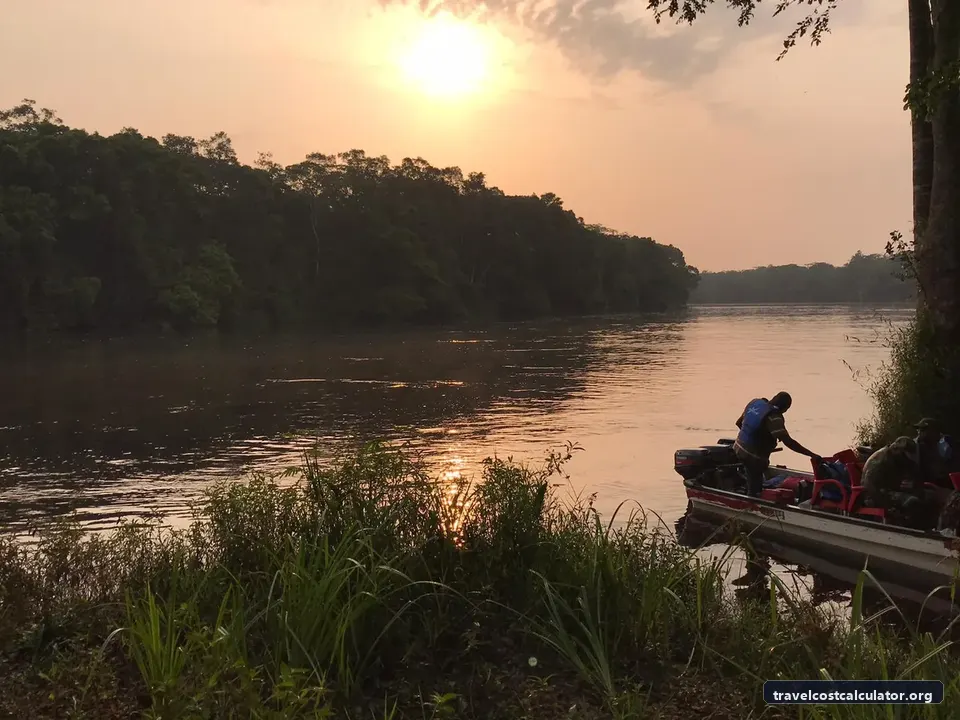
Photographing Salonga National Park requires patience, specialized gear preparation, and an eye for dense jungle landscapes. Sunlight filters through a multi-tiered jungle canopy, creating dramatic high-contrast scenes and ethereal morning mists over dark water rivers.
Top Photography Locations
-
✦
The Luilaka River Bend at Sunrise: Photograph mirror-like reflections of dense primary canopy, rising morning mist, and flocking African grey parrots drinking at the water’s edge.
-
✦
Monkoto Bonobo Observation Canopy: Located within the research buffer zone, this site offers rare opportunities to capture wild bonobo social groups, mother-infant interactions, and canopy foraging behavior.
-
✦
Salonga Salines (Forest Clearings/Baïs): Natural mineral licks deep within the forest where forest elephants, red river hogs, and sitatunga antelopes gather.
-
✦
Yaelima Traditional Settlements: Capture respectful portraiture and cultural photography of the indigenous Yaelima communities, who have coexisted sustainably with the forest ecosystem for centuries.
Insider Visit & Survival Hacks
-
✦
Optimal Seasonal Timing: Plan your trip during the primary dry seasons: June to August or December to February. Trails are far less muddy, river currents are manageable, and wildlife congregates near predictable water sources.
-
✦
Humidity & Waterproof Protection: Equatorial rainforest humidity regularly reaches 95%–100%. Pack IP67-rated waterproof dry bags, silica gel packets, and rain covers for all camera gear. Avoid changing lenses in the open forest to prevent interior condensation and fungal growth.
-
✦
Target Lens Choices: Bring a fast telephoto lens (such as a 70-200mm f/2.8 or 300mm f/2.8) because light levels under the forest canopy are extremely low, requiring high ISO settings and wide apertures.
-
✦
Health Requirements: A valid Yellow Fever vaccination certificate is strictly required for entry into the DRC. Ensure you carry full courses of Malarone/Doxycycline for malaria prophylaxis, broad-spectrum antibiotics, high-DEET insect repellent, and long, permethrin-treated clothing to guard against tsetse flies and leeches.
🏨 Nearby Accommodation & Daily Budget Allocation
Infrastructure in central DRC is exceptionally rudimentary. Accommodations range from basic conservation research guest houses to tented expedition camps. There are no commercial luxury hotels inside or directly surrounding Salonga National Park.
Accommodation Options
-
✦
ICCN Monkoto Station Guest House (Budget/Basic): Basic concrete rooms or simple beds with mosquito netting located at the park headquarters. Facilities rely on solar power, drop toilets, and bucket showers. Price: $35 – $60 USD per night.
-
✦
Tented Expedition Camps (Mid-Range): Organized by eco-tour operators or research teams, featuring heavy-duty canvas safari tents with safari cots, portable camp toilets, and dedicated bush chefs. Price: $150 – $300 USD per night (usually packaged within overall expedition costs).
-
✦
Village Homestays / Community Lodging: Very basic mud-brick rooms arranged through local village chiefs in Monkoto or Boende. Price: $15 – $30 USD per night (donation to host community).
Estimated Daily Budget Allocation (2026 Rates)
To help you structure your expedition finances, here is a realistic estimated daily expenditure per person for a mid-range guided jungle expedition to Salonga:
-
✦
ICCN Park Permits & Ranger Escort: $90 – $110 USD
-
✦
Lodging / Camp Setup: $50 – $150 USD
-
✦
Food & Clean Drinking Water Logistics: $30 – $50 USD (basic local staples, rice, canned goods, and water purification supplies)
-
✦
Local Transit & River Pirogue Fuel (Shared): $100 – $200 USD
-
✦
Tips for Rangers, Trackers & Porters: $15 – $25 USD per day
-
✦
Total Estimated Daily Budget: $285 – $535 USD per day (excluding initial domestic charter flights from Kinshasa).
For independent extreme travelers aiming for the absolute minimum budget (sharing river pirogue costs and staying in basic village housing), daily baseline operational costs average around $140 – $200 USD per day.
Frequently Asked Questions
Essential visitor FAQs for Salonga National Park
What is the entrance fee for Salonga National Park?
How much time do you need to explore Salonga National Park?
How do I get to Salonga National Park from the nearest city?
📊 Heritage Quick Specs
Visiting CD on a Budget?
Calculate your full daily travel budget for CD — including hotel costs, local transport, food, and sightseeing expenses.
View CD Daily Travel Costs →Explore more UNESCO World Heritage Sites
🏛️ All 1,200+ Heritage Sites →