
 Italy
Italy
Rhaetian Railway in the Albula / Bernina Landscapes
Rhaetian Railway in the Albula / Bernina Landscapes, brings together two historic railway lines that cross the Swiss Alps through two passes.
Rhaetian Railway in the Albula / Bernina Landscapes
🏛️ Overview & Historical Significance
Inscribed as a UNESCO World Heritage site in 2008, the Rhaetian Railway in the Albula / Bernina Landscapes represents a golden age of alpine engineering and landscape integration. Spanning 122 kilometers (76 miles) of track between Thusis in Switzerland and Tirano in Italy, this mountain railway is widely celebrated as one of the most spectacular rail journeys on Earth. Rather than conquering nature with aggressive industrial scarring, the engineers of the Rhaetian Railway (Rhätische Bahn or RhB) crafted a harmonious conduit through high-altitude passes, glaciated valleys, and sheer cliff faces.
The UNESCO listing encompasses two historic rail lines built in the early 20th century: the Albula Line (opened in 1903) and the Bernina Line (completed in 1910). Together, they feature an astounding network of 55 tunnels and galleries alongside 196 bridges and viaducts. What makes the Bernina section particularly astonishing is its sheer steepness—it climbs to an elevation of 2,253 meters (7,392 feet) at Ospizio Bernina without using a rack-and-pinion (cogwheel) system, relying entirely on friction on gradients up to 7%.
Starting from the palm-fringed Italian town of Tirano at 429 meters above sea level and ascending past icy alpine glaciers before descending into Switzerland’s Engadin valley, this trans-alpine route dissolved centuries-old physical barriers between Central and Southern Europe. Today, as you ride through this living monument in 2026, you experience an intact, functioning historical railway operating in complete harmony with the dramatic natural topography of the Rhaetian Alps.
🎟️ Entrance Fees, Opening Hours & Ticket Booking Tips
While the Rhaetian Railway is a functioning public transportation network rather than a traditional fenced-in monument, experiencing the UNESCO site requires purchasing train tickets. Travelers generally choose between the world-famous Bernina Express (panoramic tourist train with floor-to-ceiling windows) and the regular RhB Regional Trains (which run on the exact same tracks with openable windows).
Estimated 2026 Ticket Prices & Fare Options
Prices below reflect current 2026 pricing estimates in Swiss Francs (CHF), Euros (€), and US Dollars ($ USD):
-
✦
Tirano (Italy) to St. Moritz (Switzerland) – Regional Train (One-Way, 2nd Class): CHF 34.00 / €35.00 / $38.00 USD per adult.
-
✦
Tirano to St. Moritz – Bernina Express (One-Way, 2nd Class): CHF 34.00 ticket + mandatory seat reservation fee of CHF 28.00–36.00 (depending on season). Total: ~CHF 62.00–70.00 / €65.00–73.00 / $70.00–78.00 USD.
-
✦
Full UNESCO Route: Tirano to Chur (One-Way, 2nd Class): CHF 88.00 / €91.00 / $98.00 USD on regional trains; approx. CHF 124.00 / €128.00 / $138.00 USD for Bernina Express including reservation.
-
✦
Child Discounts: Children under 6 travel free. Children aged 6 to 15 receive a 50% discount on standard fares (seat reservation fees still apply on the Express).
Rail Pass Validity
If you hold a Swiss Travel Pass or an Eurail / Interrail Pass covering Switzerland, your core ticket fare is 100% covered on both regional and Bernina Express trains. However, if you choose the Bernina Express, you must pay the seat reservation surcharge separately (approx. $31–$40 USD in 2026).
Operating Hours & Timetable Schedule
-
✦
Operating Calendar: Regional trains run 365 days a year, departing roughly every hour from 05:30 to 20:30 between Tirano and St. Moritz / Chur.
-
✦
Bernina Express Schedule: Runs several times daily year-round, with increased departures during peak summer (May–October) and winter ski season (December–March).
-
✦
Booking Window: Bernina Express seat reservations open 90 days in advance. Because panoramic cars sell out weeks ahead during summer and winter peaks, early booking via the official RhB website (rhb.ch) is critical.
🚌 How to Get There & Local Transit Costs
The southern terminus of the UNESCO World Heritage route is located in Tirano, Italy, nestled in the Valtellina valley of Lombardy. Because of its direct rail connections to Milan, Tirano is the most popular, cost-effective gateway for international travelers entering from Italy.
Step-by-Step Transport from Milan to Tirano
Reaching the Rhaetian Railway starting point in Tirano from Milan is straightforward and economical:
-
✦
By Direct Train (Recommended): Board the Trenord regional express train from Milano Centrale directly to Tirano. The scenic journey skirts the eastern shore of Lake Como.
- Duration: 2 hours and 30 minutes.
-
✦
2026 Ticket Fare: €12.50 – €14.50 ($13.50 – $15.50 USD) one-way.
-
✦
Frequency: Trains run every 1 to 2 hours throughout the day.
Arriving in Tirano: Station Logistics
When you arrive in Tirano by train from Milan, you exit into the Italian Rete Ferroviaria Italiana (RFI) station. Right across the small, paved square (Piazza delle Stazioni) sits the red-fronted Stazione Rhätische Bahn. This is where you clear the seamless Swiss/Italian border point (keep your passport handy, though checks are rare under Schengen) and board the narrow-gauge Swiss trains heading uphill into the Bernina Alps.
📸 Best Photography Spots & Insider Visit Hacks
Top 4 Iconic Photography Locations
-
✦
1. The Brusio Circular Viaduct (Viadotto elicoidale di Brusio): Located just 10 minutes past the Italian border near Brusio. This 9-arched spiral viaduct allows the train to gain elevation in a tight valley. Best View: From the grassy field inside the curve or from the left-hand side of the train when heading north.
-
✦
2. Alp Grüm Station & Palü Glacier: Sitting at 2,091 meters, this station offers a panoramic view over the Val Poschiavo and the turquoise Vadret da Palü glacier. Stop off here for a coffee on the sun terrace of the station restaurant.
-
✦
3. Lago Bianco & Ospizio Bernina: The highest point of the line (2,253 meters). The contrast between the milky-turquoise glacial water of Lago Bianco and the dark blue waters of nearby Lej Nair is breathtaking, especially under crisp autumn or spring sunlight.
-
✦
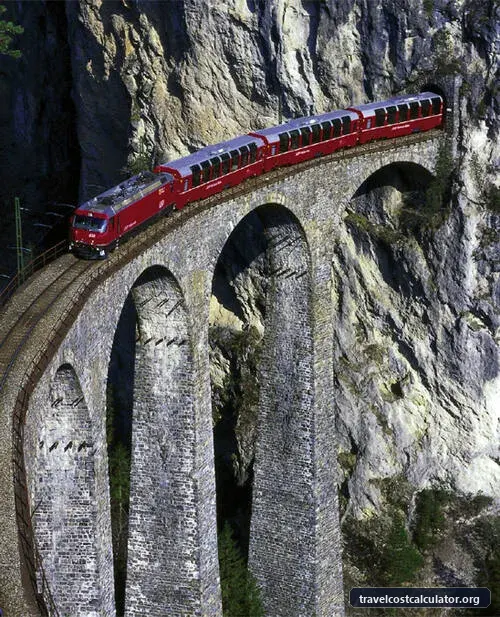
4. Landwasser Viaduct (Filisur): Located along the Albula section toward Chur. A 65-meter-high limestone viaduct that curves directly into a vertical tunnel cliff face. Best View: Take the short 20-minute hiking trail from Filisur station to the North/South viewing platforms.
Insider Visit Hacks for 2026
-
✦
The "Open Window" Secret: Skip the expensive Bernina Express panoramic cars if you are a dedicated photographer! The glass on panoramic cars causes heavy light reflection. Instead, board the regular RhB regional trains. They feature windows that drop down manually, allowing you to shoot crisp, reflection-free photos of the landscape and the iconic red train curving through the scenery.
-
✦
Strategic Seating Selection: Departing north from Tirano, sit on the LEFT side of the train for the best views of the Brusio Circular Viaduct and the climb up to Alp Grüm. Near the Bernina Pass, both sides offer incredible views of Lago Bianco and surrounding peaks.
-
✦
Seasonal Timing:
- Winter (Jan–March): Dramatic snowbound wonderland, ideal for snowscape photography.
-
✦
Autumn (October–Early Nov): Golden larch forests across the Engadin valley create a vibrant golden backdrop against blue mountain lakes.
🏨 Nearby Accommodation & Daily Budget Allocation
Because the railway spans Italy and Switzerland, accommodation costs vary dramatically depending on which side of the border you choose to stay. Staying in Tirano (Italy) offers exceptional value, delicious Lombardy dining, and budget-friendly hotels. Staying in St. Moritz or Pontresina (Switzerland) delivers luxury, alpine elegance, and high-end dining, but at significantly higher prices.
Recommended Accommodations
-
✦
Budget Pick (Tirano, Italy): Ostello del Castello Tirano or local B&Bs. Clean, cozy rooms located within walking distance of the train station. Range: $55 – $90 USD per night.
-
✦
Mid-Range Pick (Tirano, Italy): Hotel Curt Di Clement Eco-Historic Hotel or Hotel Bernina Tirano. Stylish boutique hotels featuring regional Valtellina wine bars and quick station access. Range: $130 – $210 USD per night.
-
✦
Alpine Luxury Pick (Pontresina / St. Moritz, Switzerland): Grand Hotel Kronenhof (Pontresina) or Badrutt’s Palace (St. Moritz). World-class spa resorts overlooking the Bernina glaciers. Range: $550 – $1,200+ USD per night.
Estimated Daily Budget Breakdown (Per Person, 2026 Prices)
-
✦
Budget Traveler Base (Staying in Tirano): $100 – $140 USD / day
- Accommodation (Shared/Budget B&B in Tirano): $45
-
✦
Transport (Milan train + RhB Regional Day Pass segment): $45
-
✦
Meals (Pizza, local Pizzoccheri della Valtellina pasta, gelato): $30
-
✦
Incidentals/Coffee: $10
- Accommodation (3-Star Hotel in Tirano or Samedan): $120
- Accommodation (5-Star Luxury Resort in St. Moritz): $650+
Frequently Asked Questions
Essential visitor FAQs for Rhaetian Railway in the Albula / Bernina Landscapes
What is the entrance fee for Rhaetian Railway in the Albula / Bernina Landscapes?
How much time do you need to explore Rhaetian Railway in the Albula / Bernina Landscapes?
How do I get to Rhaetian Railway in the Albula / Bernina Landscapes from the nearest city?
📊 Heritage Quick Specs
Visiting Italy on a Budget?
Calculate your full daily travel budget for Italy — including hotel costs, local transport, food, and sightseeing expenses.
View Italy Daily Travel Costs →Explore more UNESCO World Heritage Sites
🏛️ All 1,200+ Heritage Sites →