
 Argentina
Quebrada de Humahuaca
Quebrada de Humahuaca follows the line of a major cultural route, the Camino Inca, along the spectacular valley of the Rio Grande, from its source in the cold high desert plateau of the High Andean lands to its...
Quebrada de Humahuaca
🏛️ Overview & Historical Significance
Stretching 155 kilometers along the Rio Grande in Argentina’s far northern Jujuy province, the Quebrada de Humahuaca is one of the South American continent’s most breathtaking cultural landscapes. In 2003, UNESCO designated this dramatic mountain valley as a World Heritage site under the Cultural Landscape category, recognizing it as a crucial 10,000-year-old trade and cultural corridor connecting the high Andean altiplano to the southeastern South American lowlands.
For millennia, hunter-gatherer societies, pre-Incan indigenous civilizations (notably the Omaguaca people), the Incan Empire (via the legendary Qhapaq Ñan road system), Spanish conquistadors, and 19th-century independence fighters have traversed this narrow desert canyon. Each era left its indelible mark on the landscape—from pre-Columbian fortress ruins (*pucarás*) to adobe colonial churches housing priceless Cuzco-school artwork.
Geologically, Quebrada de Humahuaca is a canvas of oxidized minerals, tectonic upheavals, and wind erosion. Towering rock faces range from deep ochre and emerald green to vivid violet and brilliant white. Combined with the living Andean traditions of its indigenous inhabitants, visiting the Quebrada is as much a journey through deep geological time as it is an immersive plunge into South America’s living cultural heritage.
🎟️ Entrance Fees, Opening Hours & Ticket Booking Tips (2026 Prices)
Unlike gated national parks, the Quebrada de Humahuaca itself is a public, inhabited valley traversed by National Route 9. Accessing the main valley, towns, and scenic drives is completely free. However, specific archaeological sites, community-managed natural viewpoints, and specialized transport require ticket purchases or small entry fees.
Key Sightseeing Entrance Fees & Operating Hours
-
✦
Pucará de Tilcara Archaeological Site & Botanical Garden: ~8,000 ARS ($6.50 USD) per person. Includes entrance to the restored pre-Incan fortress and the highland cactus garden. Open Tuesday to Sunday: 9:00 AM – 6:00 PM. Closed Mondays.
-
✦
Serranía de Hornocal (14 Colors Mountain) Access Fee: ~5,000 ARS ($4.00 USD) per vehicle. Managed by the local Santa Ana indigenous community for road maintenance and lookout facilities. Open daily: 8:00 AM – 6:30 PM.
-
✦
Uquía Church (Iglesia de San Francisco de Paula): Free entry (small donation of ~$1.00 USD / 1,200 ARS appreciated for preservation). Famous for its 17th-century paintings of the Ángeles Arcabuceros (gun-toting angels). Open daily: 9:00 AM – 1:00 PM and 3:00 PM – 7:00 PM.
-
✦
Tren Solar de la Quebrada (Day Pass Tourist Ticket): ~$40 USD (approx. 50,000 ARS) for international visitors. Includes hop-on/hop-off access along the scenic rail line between Volcán and Tilcara. Departs daily from 8:00 AM to 7:00 PM.
Pro Booking & Financial Tips for 2026
-
✦
Cash is King: While credit card acceptance has improved across Argentina, cellular and Wi-Fi networks in high-altitude Andean villages like Uquía, Purmamarca, and Hornocal remain spotty. Always carry physical Argentine Pesos (ARS) or US Dollars in small denominations. Card terminals at ticket booths frequently go offline.
-
✦
Ticket Purchasing: Tickets for site entries (like Pucará de Tilcara) are sold directly on-site at official ticket windows. Advance booking is generally not required, except for the Tren Solar de la Quebrada, which should be reserved online at least 3 to 5 days in advance during peak holiday seasons (July winter break and Carnival in February).
🚌 How to Get There & Local Transit Costs
The main gateways to Quebrada de Humahuaca are San Salvador Travel Budget de Jujuy (JUJ) and Salta (SLA), both of which feature modern airports with multiple daily flights from Buenos Aires Travel Budget, Córdoba, and Mendoza Travel Budget.
Step-by-Step Transport Options
1. By Direct Local Bus (Most Budget-Friendly)
From the main bus terminal in San Salvador de Jujuy (Terminal de Ómnibus de Jujuy), several local bus lines (such as Evelia, Panamericano, and Balut) run north along Route 9 every 30 to 45 minutes.
-
✦
Jujuy to Purmamarca: ~1.5 hours | 5,500 ARS ($4.50 USD)
-
✦
Jujuy to Tilcara: ~2 hours | 7,000 ARS ($5.80 USD)
-
✦
Jujuy to Humahuaca Town: ~3 hours | 9,500 ARS ($7.80 USD)
2. By Tren Solar de la Quebrada (Eco-Scenic Experience)
Argentina’s modern lithium-battery powered tourist train offers a smooth, quiet, and eco-friendly ride through the valley. It currently connects stations at Volcán, Tumbaya, Purmamarca, Maimará, and Tilcara.
-
✦
Foreign Tourist Pass: ~$40.00 USD for a full-day hop-on, hop-off pass.
-
✦
Best Use: Ideal for travelers staying in Tilcara or Purmamarca who want to explore neighboring villages without driving.
3. By Rental Car or Private Tour
Renting a vehicle in Salta or Jujuy offers maximum freedom to explore dirt side-roads like the Paseo de los Colorados or the high-altitude winding road to Hornocal. Standard sedan rentals cost approximately $45 to $70 USD per day in 2026. A 4x4 vehicle is not strictly necessary for main roads, but extra ground clearance is helpful for the road to Hornocal.
4. Getting to Serranía de Hornocal from Humahuaca Town
The 14-Colored Mountain sits 25 km east of Humahuaca town along a winding gravel road that climbs to 4,350 meters altitude. If you don't have a car, shared 4x4 remises (taxis) depart continuously from the Humahuaca bus station area.
-
✦
Shared 4x4 Excursions: ~$10 – $15 USD (12,000 – 18,000 ARS) per person round-trip, including a 45-minute wait time at the panoramic lookout point.
📸 Best Photography Spots & Insider Visit Hacks
Must-Capture Photography Locations
-
✦
Cerro de los Siete Colores (Purmamarca): Early morning light (8:00 AM – 10:00 AM) is vital. The morning sun illuminates the western face of the mountain, making the pink, green, yellow, and red layers glow without harsh overhead shadows.
-
✦
Serranía de Hornocal (Humahuaca): Late afternoon only! Visit between 3:30 PM and 5:30 PM. In the morning, the sun is directly behind the peaks, creating heavy silhouetting. The late afternoon golden hour hits the zig-zag mineral ribbons directly, creating extraordinary contrast.
-
✦
Paleta del Pintor (Maimará): Best photographed from the highway turnout across the valley during mid-afternoon when sunlight spreads across the dramatic triangular geological folds.
-
✦
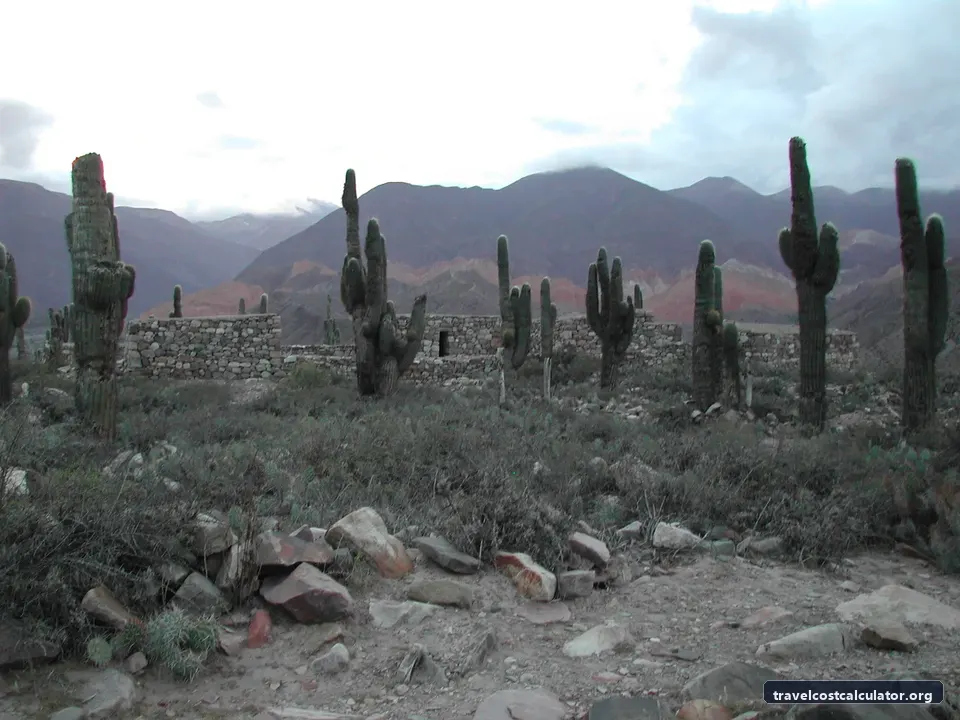
Pucará de Tilcara: Photograph the giant Cardón cacti framing the ancient stone ruins against the backdrop of the Quebrada during mid-morning.
Insider Hacks & Health Logistics
-
✦
Altitude Management (Soroche Prevention): Altitudes in the valley range from 2,300 meters (Purmamarca) to 4,350 meters (Hornocal Viewpoint). Avoid severe altitude sickness by starting your stay in Purmamarca or Tilcara before heading up to Humahuaca and Hornocal. Stay hydrated, avoid heavy meals on your first night, and sip local té de coca (coca leaf tea).
-
✦
Beating the Tour Bus Crowds: Large tour buses from Salta flood Purmamarca between 11:30 AM and 2:30 PM. Plan your village walks before 10:30 AM or after 4:00 PM when the main square returns to its peaceful original state.
-
✦
Seasonal Packing Strategy: The Andean desert experiences extreme thermal amplitude. Summer days (Dec–Feb) can reach 26°C (79°F) with occasional heavy rain, while winter nights (June–Aug) frequently dip below freezing (-5°C / 23°F). Layering thermal clothing, windproof jackets, high-SPF sunscreen, and polarized sunglasses is mandatory year-round.
🏨 Nearby Accommodation & Daily Budget Allocation
Choosing where to base yourself depends on your travel style. Purmamarca offers upscale charm and scenic quiet; Tilcara is the vibrant cultural heart with excellent restaurants and peñas (traditional live music venues); and Humahuaca provides budget-friendly lodging close to Hornocal.
Recommended Stays in 2026
-
✦
Budget Pick (Hostels/Guesthouses): Hostal Cerro de las Rosas (Tilcara) or Hostal La Humahuaqueña (Humahuaca). Private rooms from $20 to $35 USD per night; dorm beds around $10 to $14 USD.
-
✦
Mid-Range Pick (Boutique Adobe Hotels): Hotel La Posada del Marqués (Tilcara) or Hotel Casa de Piedra (Purmamarca). Authentic high-altitude architecture with modern comforts from $70 to $120 USD per night including regional breakfast.
-
✦
Luxury Pick (High-End Eco-Resorts): El Manantial del Silencio (Purmamarca). Luxury Spanish colonial-style hotel featuring spa treatments, high-end gastronomy, and mountain views from $220 to $380 USD per night.
Estimated Daily Budget Breakdowns (Per Person)
1. Backpacker / Low-Budget
-
✦
Accommodation: $12 USD (Hostel dorm bed)
-
✦
Meals: $12 USD (Empanadas, street food tamales, daily menú del día)
-
✦
Transport: $6 USD (Local public buses)
-
✦
Attractions: $5 USD (Site entry fees)
-
✦
Total Estimated Daily Cost: $35 USD / day
2. Mid-Range Traveler (Recommended)
-
✦
Accommodation: $45 USD (Shared mid-range boutique room)
-
✦
Meals: $30 USD (Dining at traditional peñas, sampling local llama tenderloin & regional wine)
-
✦
Transport: $20 USD (Tren Solar daily pass or shared 4x4 trip to Hornocal)
-
✦
Attractions: $10 USD (Museum & site access)
-
✦
Total Estimated Daily Cost: $105 USD / day
3. Luxury / Comfort Traveler
-
✦
Accommodation: $150 USD (Luxury hotel suite)
-
✦
Meals: $70 USD (Gourmet regional cuisine paired with high-altitude Jujuy Malbecs)
-
✦
Transport: $60 USD (Private car rental / driver allocation)
-
✦
Attractions: $25 USD (Private guided historical tours)
-
✦
Total Estimated Daily Cost: $305 USD / day
Frequently Asked Questions
Essential visitor FAQs for Quebrada de Humahuaca
What is the entrance fee for Quebrada de Humahuaca?
How much time do you need to explore Quebrada de Humahuaca?
How do I get to Quebrada de Humahuaca from the nearest city?
📊 Heritage Quick Specs
Visiting Argentina on a Budget?
Calculate your full daily travel budget for Argentina — including hotel costs, local transport, food, and sightseeing expenses.
View Argentina Daily Travel Costs →Explore more UNESCO World Heritage Sites
🏛️ All 1,200+ Heritage Sites →