
 Brazil
Pantanal Conservation Area
The Pantanal Conservation Area consists of a cluster of four protected areas with a total area of 187,818 ha.
Pantanal Conservation Area
🏛️ Overview & Historical Significance
Inscribed as a UNESCO World Heritage site in 2000, the Pantanal Conservation Area—comprising the Pantanal Mato-Grossense National Park and the neighboring private reserves of Acurizal, Penha, and Dorochê—represents one of the most critical ecological sanctuaries on Earth. Spanning over 187,000 hectares in the state of Mato Grosso, this protected core lies within the broader Pantanal basin: the world's largest tropical wetland ecosystem.
UNESCO designated the area for its extraordinary biological richness and its function as an ecological bridge. Positioned at the intersection of the Amazon rainforest, the Cerrado savanna, the Chaco dry forests, and the Atlantic forest, the Pantanal creates a hyper-biodiverse haven where flora and fauna from distinct biomes converge. The annual flood cycle—where up to 80% of the plain submerges beneath nutrient-rich waters during the wet season—drives an unprecedented pulse of life.
Unlike dense rainforests where wildlife remains concealed beneath high canopies, the open savanna wetlands of the Pantanal offer unobstructed natural sightings. The conservation area protects critical populations of globally threatened species, including the world’s highest density of wild Jaguars (Panthera onca), the Giant River Otter, the Hyacinth Macaw, the Giant Anteater, and millions of Yacare Caimans. Visiting this UNESCO sanctuary provides a rare window into an intact, highly functioning mega-ecosystem that continues to undergo natural evolutionary processes untouched by industrial development.
🎟️ Entrance Fees, Opening Hours & Ticket Booking Tips
Navigating access to the Pantanal Conservation Area requires understanding that it is a wilderness area protected by ICMBio (the Chico Mendes Institute for Biodiversity Conservation) alongside private eco-reserves. Most visits are conducted through authorized safari lodges, certified vessel captains, and local expedition operators.
Estimated 2026 Entry & Permit Costs
-
✦
National Park Access Permit: Nominal park entry permits range from R$ 45 to R$ 90 BRL (~$9 to $18 USD) per person per day when accessing state and national park boundaries via certified river charters.
-
✦
Private Reserve Conservation Fees: Private reserves (such as those integrated into the UNESCO area) charge daily environmental conservation fees of R$ 120 to R$ 260 BRL (~$24 to $52 USD) per visitor.
-
✦
Full-Day Jaguar Tracking Boat Charters (Porto Jofre): Small motorboats with local river guides cost between R$ 1,800 and R$ 3,600 BRL (~$360 to $720 USD) per boat/day. When Split Travel Budget between 2 to 4 travelers, this averages $90 to $180 USD per person daily.
Opening Hours & Access Schedules
The protected natural areas are technically accessible 24 hours a day for guests staying at wilderness lodges. However, regulated boat safaris within the core national park boundaries and Meeting of the Waters State Park operate strictly between 06:00 AM and 06:00 PM to protect nocturnal animal behaviors. Private reserves permit nocturnal spotlighting safaris between 08:00 PM and 10:30 PM with licensed naturalists.
Pro Booking Hacks for 2026
-
✦
Book 6 to 9 Months Ahead: Peak dry season (July through October 2026) sees high demand for specialized boat captains and floating flotels near Porto Jofre. Reserve early to lock in certified guides.
-
✦
Verify ICMBio Accreditation: Ensure your tour operator or boat captain carries active ICMBio and CADASTUR registration. Unregistered boatmen face steep fines and may be turned back at park river checkpoints.
-
✦
All-Inclusive Eco-Lodge Packages: Securing a package with a land-based lodge along the Transpantaneira Highway often bundles park entry permits, boat fuel, and certified naturalist guides at a lower combined rate than booking à la carte.
🚌 How to Get There & Local Transit Costs
The Pantanal is divided into North and South regions. The core UNESCO Pantanal Conservation Area is most directly accessed via the **Northern Pantanal** gateway of **Cuiabá** (Marechal Rondon International Airport - CGB).
Step-by-Step Route from Cuiabá to the Core Conservation Zone
To reach the heart of the reserve, travelers head south from Cuiabá to the gateway town of Poconé, then traverse the famous Transpantaneira Highway (MT-060)—a 145-kilometer unpaved dirt road featuring over 120 wooden bridges—ending at Porto Jofre on the Cuiabá River.
-
✦
Step 1: Arrive in Cuiabá (CGB): Direct domestic flights land daily from São Paulo (GRU/VCP), Rio de Janeiro Travel Budget (GIG), and Brasília (BSB).
-
✦
Step 2: Cuiabá to Poconé:
- Intercity Bus: Regular buses run from Cuiabá’s Rodoviária terminal to Poconé. Cost: R$ 35 to R$ 55 BRL (~$7 to $11 USD); duration: 1.5 to 2 hours.
-
✦
Private Taxi / Uber: Direct transfers to Poconé cost roughly R$ 250 to R$ 380 BRL (~$50 to $76 USD).
- Self-Drive 4x4 Rental: Renting a high-clearance SUV or 4x4 in Cuiabá costs R$ 350 to R$ 650 BRL (~$70 to $130 USD) per day. A 4x4 is essential during transition months (May-June, November) due to muddy road conditions.
📸 Best Photography Spots & Insider Visit Hacks
Top Photography Locations
-
✦
The Cuiabá River & Encontro das Águas (Meeting of the Waters): Adjacent to the UNESCO core, this river system boasts the highest concentration of wild Jaguar sightings on Earth. Frame shots of jaguars hunting caimans along sandbanks from low-angle safari boats.
-
✦
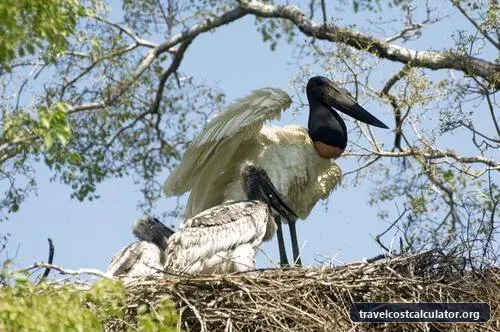
Transpantaneira Wooden Bridges: Early morning light off the wooden bridges yields iconic photographs of Yacare Caimans stacked along drying pools, framed by Jabiru Storks (the symbol of the Pantanal) and Roseate Spoonbills.
-
✦
Rio Pixaim & Rio Clarinho: Quiet river tributaries ideal for telephoto photography of Giant River Otters fishing, Agami Herons, and five distinct species of Kingfishers.
Seasonal Timing & Weather Strategy
The Pantanal experiences two primary seasons, each offering distinct visual landscapes:
-
✦
Dry Season (July to October - Peak Wildlife & Photography): Water recedes into permanent channels, drawing wildlife to riverbanks. Temperatures range from 28°C to 38°C (82°F–100°F). This is the prime window for Jaguar tracking.
-
✦
Wet/Flood Season (December to March): The landscape transforms into a vast freshwater mirror, offering surreal reflection photography. Wildlife disperses to high ground (cordilheiras); birdwatching is exceptional, though land travel along the Transpantaneira becomes challenging.
Insider Travel Hacks
-
✦
Camera Equipment: Pack a fast zoom lens (100-400mm or 200-600mm) for skittish birdlife, paired with a secondary 24-70mm lens for sweeping swamp landscapes. Carry dust covers for gear while driving the dirt highway.
-
✦
Insect Protection Strategy: Mosquitoes and blackflies (*borrachudos*) can be relentless. Bring Icaridin- or DEET-based repellents, insect-shield clothing, and wide-brimmed hats with fine mesh nets for jungle walks.
-
✦
Cash is Essential: Cell service dies south of Poconé. Credit cards are accepted at major lodges, but local boat captains, tips, and highway roadside stalls operate strictly in cash (Brazilian Reais - BRL).
🏨 Nearby Accommodation & Daily Budget Allocation
Accommodation in the Pantanal ranges from basic rustic ranches (*pousadas*) to high-end safari lodges and floating hotel suites (*flotels*) moored directly in jaguar territory.
Recommended Accommodation Tiers (2026 Estimates)
-
✦
Budget / Hostal Pousadas (Poconé Gateway): R$ 180 to R$ 350 BRL (~$36 to $70 USD) per night. Ideal for independent travelers using Poconé as a base for day excursions into the northern highway section.
-
✦
Mid-Range Wildlife Eco-Lodges (Transpantaneira KM 10 to KM 100): R$ 1,200 to R$ 2,500 BRL (~$240 to $500 USD) per night. Includes full-board meal plans (buffet style with regional Pantaneiro dishes) and scheduled group land/boat safaris.
-
✦
Luxury Safaris & Floating Flotels (Porto Jofre / River Sector): R$ 4,200 to R$ 8,800 BRL (~$840 to $1,760 USD) per night. Offers private air-conditioned cabins on the water, high-speed customized safari vessels, expert bilingual naturalists, and gourmet meals.
Estimated Daily Budget Profiles (2026)
To help plan your trip financially, consider these three daily spend projections (inclusive of stay, meals, transport, and guided activities):
-
✦
Backpacker / Independent Explorer: $90 to $140 USD per day. Requires self-driving or using public buses to Poconé, staying in budget town pousadas, self-catering meals, and joining shared group boat trips.
-
✦
Mid-Range Safari Traveler: $320 to $580 USD per day. Includes staying at an all-inclusive eco-lodge along the highway, shared boat tours, lodge transfers, and local guide gratuities.
-
✦
Luxury Photography Expedition: $950 to $1,900 USD per day. Includes floating hotel accommodation deep in the reserve, private 4x4 transfers from Cuiabá airport, dedicated motorboat with private naturalist guide, and park conservation permits.
Frequently Asked Questions
Essential visitor FAQs for Pantanal Conservation Area
What is the entrance fee for Pantanal Conservation Area?
How much time do you need to explore Pantanal Conservation Area?
How do I get to Pantanal Conservation Area from the nearest city?
📊 Heritage Quick Specs
Visiting Brazil on a Budget?
Calculate your full daily travel budget for Brazil — including hotel costs, local transport, food, and sightseeing expenses.
View Brazil Daily Travel Costs →Explore more UNESCO World Heritage Sites
🏛️ All 1,200+ Heritage Sites →