
 China
China
Mount Taishan
The sacred Mount Tai ('shan' means 'mountain') was the object of an imperial cult for nearly 2,000 years, and the artistic masterpieces found there are in perfect harmony with the natural landscape.
Mount Taishan
🏛️ Overview & Historical Significance
Rising majestically above the North China Plain in Shandong Province, Mount Taishan (泰山) is not merely a mountain; it is the spiritual bedrock of Chinese civilization. Standing at 1,545 meters (5,069 feet) at its highest point, Jade Emperor Peak (Yuhuangding), Taishan is revered as the foremost of China's "Five Sacred Mountains of Taoism" (五岳之首, Wǔyuè Zhī Shǒu). Associated with the sunrise, birth, and renewal, it has served as a place of divine worship for over 3,000 years.
In 1987, UNESCO inscribed Mount Taishan as one of the world's very first Mixed Cultural and Natural World Heritage Sites. UNESCO designated the sacred peak based on its unparalleled synthesis of human artistry and natural grandeur:
-
✦
Imperial Pilgrimage Site (Fengshan Sacrifices): For millennia, Chinese emperors believed that Mount Taishan was the supreme nexus between Heaven and Earth. At least 72 emperors—including Qin Shi Huang (the first emperor of unified China), Han Wudi, and Emperor Qianlong—made official state pilgrimages here to perform the Fengshan (封禅) rituals, offering sacrifices to declare their divine mandate to rule.
-
✦
A Living Museum of Calligraphy & Architecture: The mountain contains over 1,000 historic stone inscriptions carved directly into granite cliffs across two dynasties of calligraphic styles. Highlights include the massive 6th-century Diamond Sutra carved into the bedrock of Sutra Valley (Jingshi Yu) and imperial panegyrics dating back to the Han and Tang dynasties. Over 20 ancient temple complexes line the summit and ascent routes.
-
✦
Geological Antiquity & Natural Diversity: Geologically, Mount Taishan sits on a Pre-Cambrian metamorphic complex over 2.8 billion years old, offering a window into the Earth's early crust formation alongside dense pine forests, ancient cypress trees planted during the Han Dynasty, and dramatic cliff topography.
-
✦
Literary Iconography: Mount Taishan inspired China's greatest poets, including Du Fu, who famously wrote of Taishan: "I shall reach the summit and look down upon all other hills."
🎟️ Entrance Fees, Opening Hours & Ticket Booking Tips
Visiting Mount Taishan in 2026 requires navigating an efficient, fully digital entry system. Prices are regulated by the provincial government, with seasonal variations.
2026 Admission & Transport Pricing Breakdown
-
✦
Main Mountain Entrance Ticket (Standard Peak Season: Feb 1 – Nov 30): 115 RMB (~$16.00 USD / €14.80) per adult.
-
✦
Main Mountain Entrance Ticket (Off-Peak Season: Dec 1 – Jan 31): 100 RMB (~$14.00 USD / €13.00) per adult.
-
✦
Dai Temple (at the foot of the mountain): 20 RMB (~$2.80 USD). Note: Included automatically in some combined passes.
-
✦
Tourist Sightseeing Bus (Tianwaicun to Zhongtianmen - Middle Heaven Gate): 35 RMB (~$5.00 USD) one-way.
-
✦
Cable Car (Zhongtianmen to Nantianmen - South Heaven Gate): 100 RMB (~$14.00 USD) one-way.
-
✦
Peach Blossom Ravine (Taohuayuan) Cable Car: 100 RMB (~$14.00 USD) one-way.
-
✦
Children & Senior Discounts: Children under 1.4 meters enter free. Visitors aged 60+ (including international tourists presenting a valid passport) receive half-price or free admission depending on ticket type.
Opening Hours & Access
-
✦
Mountain Trails & Gates: Open 24 hours a day, 365 days a year. This allows night hikers to ascend the mountain under starlight for sunrise.
-
✦
Cable Cars & Sightseeing Buses: Generally operate daily from 6:30 AM to 5:30 PM (hours extend slightly during summer peak months and peak sunrise periods).
Crucial 2026 Ticket Booking Tips
China operates an absolute real-name registration system. Physical paper tickets are obsolete.
-
✦
Passport Requirement: International travelers MUST bring their physical passport. Your passport number is tied directly to your digital ticket barcode inside the reservation system.
-
✦
Advance Reservation: Tickets open 7 days in advance. During peak holidays (Golden Week in early October, Labor Day in early May, and summer weekends), tickets sell out rapidly. Book tickets in advance via the official WeChat mini-program (search "泰山景区" - Taishan Jingqu) or trusted online travel agencies like Trip.com.
-
✦
Payment Methods: cash is rarely accepted at turnstiles. Link a foreign credit card to Alipay or WeChat Pay before your arrival in China for seamless tap-to-pay purchases at turnstiles, vending machines, and food stalls.
🚌 How to Get There & Local Transit Costs
Mount Taishan is situated in Tai'an City, directly south of Jinan (the provincial capital of Shandong). China's High-Speed Rail (HSR) network makes reaching the mountain remarkably effortless from major metropolitan centers.
Step 1: High-Speed Train to Tai'an
-
✦
From Jinan (Jinan West / Jinan Railway Station): 17 to 25 minutes on any G-series bullet train. Tickets cost ~30 RMB ($4.20 USD). Jinan Yaoqiang International Airport (TNA) is the closest airport; take an airport shuttle or taxi to Jinan West Station first.
-
✦
From Beijing Travel Budget (Beijing South Station): 1 hour 45 minutes to 2 hours 15 minutes on a direct G-train. Second-class tickets cost ~185–210 RMB ($26.00–$29.00 USD).
-
✦
From Shanghai Travel Budget (Shanghai Hongqiao Station): 3.5 to 4 hours on direct G-trains. Second-class tickets cost ~380–420 RMB ($53.00–$58.00 USD).
Step 2: Onward Transit from Tai'an Railway Stations to Mount Taishan
Tai'an has two main passenger train stations. Be sure you know which one you arrive at:
-
✦
Tai'an High-Speed Railway Station (泰安站 - Tai'an Zhan): This is where almost all bullet trains arrive.
- By Public Bus: Catch Bus 37 or Bus 61 directly to the Red Gate (Hongmen) or Tianwaicun entrance. Transit time is ~45 minutes; fare is 3 RMB ($0.40 USD).
-
✦
By Taxi / Taxi App (Didi): Takes ~25 minutes to the Red Gate. Cost ranges from 25 to 35 RMB ($3.50–$5.00 USD).
- By Public Bus: Bus 3 or Bus 4 goes straight to Red Gate in 15 minutes for 2 RMB ($0.28 USD).
Choosing Your Ascent Route
-
✦
The Imperial Red Gate Route (Hongmen / 红门): The classic hiking path. 7,200 stone steps from foot to summit. Takes 4 to 6 hours. Ideal for night climbers and traditionalists.
-
✦
The Heavenly Outer Village Route (Tianwaicun / 天外村): The bus-plus-cable-car lazy route. Take the official shuttle bus up to Middle Heaven Gate (Zhongtianmen), then take the 10-minute cable car to South Heaven Gate (Nantianmen). Reaches the upper area in under an hour.
📸 Best Photography Spots & Insider Visit Hacks
Prime Photography Locations
-
✦
Sun Viewing Peak (Riguang Feng / 日观峰): Positioned on the eastern ridge of the summit. This is the premier location to capture the famous Taishan Sunrise breaking through a sea of clouds (Yunhai). Arrive 45 minutes before solar dawn to secure a spot along the stone railing.
-
✦
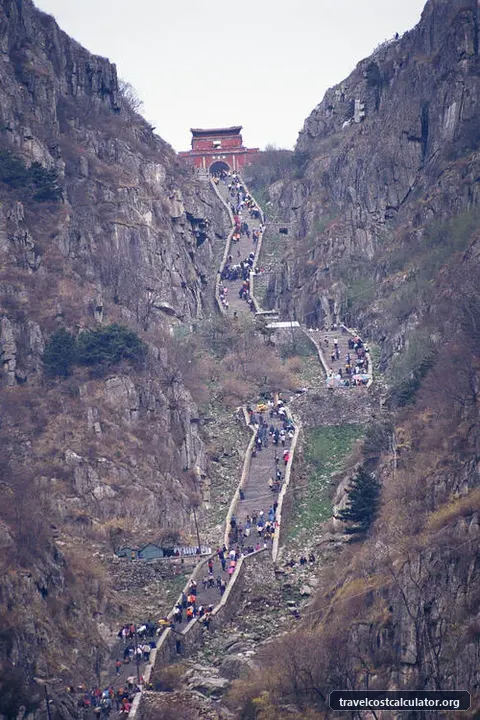
The 18 Mountain Turns (Shibapan / 十八盘): The steepest, most dramatic section of the climb—1,600+ vertical steps carved into a narrow mountain gorge framed by rock walls, leading upward to the towering red facade of South Heaven Gate (Nantianmen). Photograph looking up from the base of Shibapan, or looking down from Nantianmen.
-
✦
Jade Emperor Peak (Yuhuangding / 玉皇顶): The absolute summit (1,545m). Stand at the central stone altar surrounded by prayer padlocks and incense smoke, framing the sweeping vistas of the Shandong ridges below.
-
✦
Sutra Valley (Jingshi Yu / 经石峪): Located off the Red Gate trail, this flat granite riverbed features massive 50cm-wide Buddhist characters engraved into stone over 1,400 years ago. Shoot early in the morning when low angle light highlights the stroke depth of the rock carvings.
-
✦
Heavenly Street (Tianjie / 天街): A paved mountain village street suspended 1,400 meters above sea level, lined with red-tiled roofs, lanterns, and ancient stone facades. Stunning during dusk and golden hour.
Insider Visit Hacks
-
✦
The Night Climb Strategy: Join thousands of domestic pilgrims in the popular tradition of climbing Taishan overnight. Start walking from Red Gate around 11:00 PM to 11:30 PM. You will reach the summit around 4:30 AM, just in time for sunrise—saving you a hotel night fee while avoiding the brutal midday sun during summer.
-
✦
Rent an Army Coat (Jun Daji): Temperatures at the summit can be 10°C–15°C (18°F–27°F) colder than in Tai'an city, with severe wind chill before dawn. Don't haul heavy winter jackets up 7,000 steps; rent heavy green padded military coats at the summit for 30–50 RMB ($4.20–$7.00 USD) plus a small deposit.
-
✦
Avoid Chinese Peak Holidays: Mount Taishan experiences extreme overcrowding during National Day (Oct 1–7) and May Day (May 1–5), where stairways become completely congested. Travel during shoulder months (April, May, September, or October outside holidays) for clear skies and manageable crowds.
-
✦
Bring Trekking Poles & Kneepads: Descent down 7,000 granite steps is brutal on joints. Metal-tipped poles are restricted at turnstiles; buy wooden bamboo walking sticks from street vendors at the foot of the mountain for just 2–5 RMB ($0.30–$0.70 USD).
🏨 Nearby Accommodation & Daily Budget Allocation
Depending on whether you sleep in Tai'an city or stay at the summit to capture sunrise without night climbing, travel costs vary significantly.
Accommodation Options
-
✦
Summit Hotels (Luxury/Convenience): Staying on top of the mountain (e.g., Shenqihua Hotel or Yundingshanzhuang) allows you to step directly out onto Sun Viewing Peak for sunrise. Rooms are basic due to high altitude and water logistics, costing 600–1,200 RMB ($85–$165 USD) per night. Book months ahead.
-
✦
Mid-Range City Hotels (Tai'an Foot of Mountain): Excellent modern 3-star and 4-star hotels sit right outside the Red Gate or near Tai'an HSR station (e.g., Ramada, Hampton by Hilton, or local boutique inns). Rates run 250–450 RMB ($35–$62 USD) per night.
-
✦
Budget Hostels & Night Hiking (Shoestring): Hostels near the Red Gate cost 60–120 RMB ($8–$17 USD) for a dorm bed. Alternatively, spend $0 on lodging by embarking on the midnight hike!
Local Dining Costs
Shandong cuisine (Lu cuisine) is hearty and savory. Try local specialties like Taishan Tofu Soup (泰山豆腐), Shandong Pancake Wraps with Scallions (山东煎饼卷大葱), and claypot chicken.
-
✦
City Meals: Casual street meal: 15–30 RMB ($2.00–$4.20 USD). Sit-down dinner for two: 100–180 RMB ($14.00–$25.00 USD).
-
✦
Summit Food: Prices increase significantly due to porter transportation. Simple instant noodles at summit stalls cost 15–20 RMB ($2.00–$2.80 USD); hot sausages cost 10 RMB ($1.40 USD). Bring your own high-energy snacks and water up the mountain.
Daily Budget Estimations (2026 Rates)
-
✦
Backpacker / Backpacker Budget Planner (~$45 - $60 USD per day)
- Transportation: Public bus from station (5 RMB)
-
✦
Accommodation: Night climb (0 RMB) or Budget hostel bed (90 RMB / $12.50 USD)
-
✦
Attractions & Fees: Entrance ticket (115 RMB / $16 USD)
-
✦
Food & Water: Local snacks, street pancakes, instant noodles at peak (100 RMB / $14 USD)
- Transportation: High-speed rail connection + Didi taxis + Tourist Shuttle Bus + Cable Car one-way (250 RMB / $35 USD)
- Transportation: 1st Class HSR + Private taxis + Round-trip Cable Cars & Shuttle Buses (450 RMB / $62 USD)
Frequently Asked Questions
Essential visitor FAQs for Mount Taishan
What is the entrance fee for Mount Taishan in 2026?
How much time do you need to explore Mount Taishan?
How do I get to Mount Taishan from the nearest city?
📊 Heritage Quick Specs
Visiting China on a Budget?
Calculate your full daily travel budget for China — including hotel costs, local transport, food, and sightseeing expenses.
View China Daily Travel Costs →Explore more UNESCO World Heritage Sites
🏛️ All 1,200+ Heritage Sites →