
 Iran
Masjed-e Jāmé of Isfahan
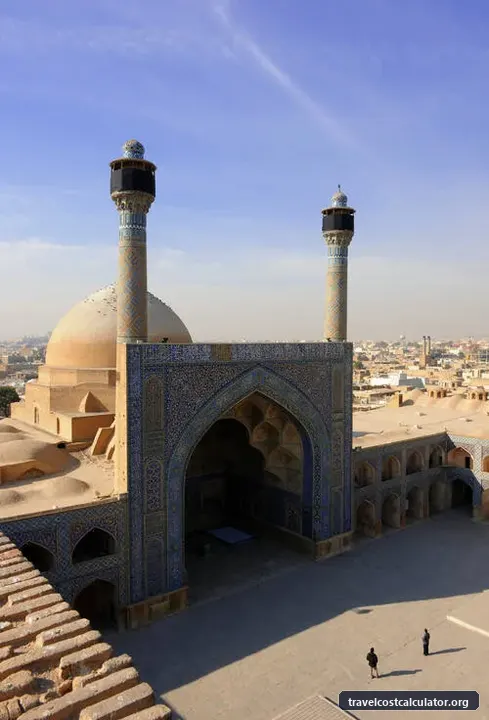
Located in the historic centre of Isfahan, the Masjed-e Jāmé (‘Friday mosque’) can be seen as a stunning illustration of the evolution of mosque architecture over twelve centuries, starting in ad 841.
Masjed-e Jāmé of Isfahan
🏛️ Overview & Historical Significance
Inscribed as a UNESCO World Heritage site in 2012, the Masjed-e Jāmé of Isfahan Travel Budget (also known as the Grand Mosque or Friday Mosque of Isfahan) stands as the ultimate architectural palimpsest of Islamic civilization. Spanning over 20,000 square meters in the historic core of Isfahan, this sprawling sanctuary is not merely a single monument; it is a 1,200-year living museum that chronicles the structural evolution of Persian, Seljuk, Ilkhanid, Timurid, and Safavid sacred design from the 8th century through the late 20th century.
The site original origins trace back to an 8th-century Abbasid hypostyle mosque built over an earlier Sasanian Zoroastrian fire temple. However, its historic architectural transformation occurred under the Seljuk Dynasty in the 11th century. Vizier Nizam al-Mulk ordered the construction of a massive southern brick dome in 1086 CE, challenging traditional pillar-heavy layouts. Shortly after, his political rival Taj al-Mulk erected the northern dome in 1088 CE—a mathematical masterpiece of brickwork geometric harmony widely considered by architectural historians to possess ideal golden-ratio proportions.
UNESCO recognized the Jāmé Mosque primarily because it served as the archetype for the four-iwan courtyard design. By placing four grand vaulted halls (iwans) around an open-air central courtyard, the master builders created a structural template that subsequently influenced mosque and madrasa architecture across Iran, Central Asia, and Mughal India. From the exquisite 14th-century carved stucco mihrab of Sultan Uljaitu to the complex vaulting of over 470 distinct brick domes, Masjed-e Jāmé is widely regarded by scholars as the most artistically complete complex in Islamic architectural history.
🎟️ Entrance Fees, Opening Hours & Ticket Booking Tips
Visiting Masjed-e Jāmé in 2026 requires understanding Iran's specific ticketing system and local currency mechanics. Ticket prices for international visitors are standardized by the Ministry of Cultural Heritage, Tourism and Handicrafts (MCTH).
-
✦
Foreign Tourist Ticket Fee (2026 Estimate): ~2,500,000 IRR to 3,000,000 IRR (equivalent to $5.00 – $6.50 USD / €4.50 – €6.00 EUR depending on current exchange rates).
-
✦
Domestic / Iranian Resident Fee: ~100,000 IRR.
-
✦
Standard Opening Hours: Daily from 9:00 AM to 11:00 AM and 1:00 PM to 5:00 PM (Closing times extend to 6:00 PM during spring/summer months).
-
✦
Prayer Closures: The complex closes to non-Muslim sightseers during daily prayer hours and is restricted during Friday Congregational Prayers (Juma) until early afternoon.
Crucial 2026 Payment & Ticket Hacks:
-
✦
Cash Only / Tourist Debit Cards: Due to ongoing international banking sanctions, foreign credit and debit cards (Visa, Mastercard, Amex) do not work in Iran. You must pay in cash using local currency (Iranian Rials or Tomans) or use a pre-funded Iranian Tourist Debit Card (such as MahCard or Daric Pay), which can be loaded with cash upon arrival at major airports or foreign exchange offices (Sarrafi).
-
✦
Understanding Toman vs. Rial: Prices are quoted officially in Rials, but locals speak in Tomans (1 Toman = 10 Rials). A 2,500,000 Rial ticket is 250,000 Tomans. Always double-check which unit is being quoted.
-
✦
Dress Code Compliance: Women must wear headcovers (hijab) and loose clothing covering arms and legs. At the entrance of Masjed-e Jāmé, women are provided with a full-length floral chador free of charge, which must be worn inside the sacred precinct. Men must wear long trousers and shirts covering the shoulders.
🚌 How to Get There & Local Transit Costs
Masjed-e Jāmé is located at Qeyam Square (Atiq Square) at the northern end of Isfahan’s historical Grand Bazaar. It sits approximately 2.5 kilometers north of Naqsh-e Jahan Square, making it easy to integrate into a day walking tour.
1. On Foot from Naqsh-e Jahan Square
The most atmospheric way to reach the mosque is walking north through the covered corridors of the Grand Bazaar (Bazaar-e Bozorg). The walk takes roughly 35 to 45 minutes, passing copper smiths, spice vendors, and antique merchants before emerging right at the mosque's eastern entrance. Walking is entirely free and highly recommended for cultural immersion.
2. By Ride-Hailing App (Snapp) or Taxi
Snapp (the Iranian equivalent of Uber) is the safest, most transparent, and most economical transport option in Isfahan. You can download the app and use it with an Iranian local SIM card (MCI or Irancell).
-
✦
Fare from Naqsh-e Jahan Square / City Center: ~150,000 – 250,000 IRR ($0.30 – $0.60 USD).
-
✦
Fare from Kaveh Bus Terminal (North): ~250,000 – 400,000 IRR ($0.50 – $0.85 USD).
-
✦
Fare from Soffeh Bus Terminal (South): ~400,000 – 600,000 IRR ($0.85 – $1.30 USD).
-
✦
Street Taxis (Darbast): Negotiate price before entering; typical city center fares run around 300,000 – 500,000 IRR ($0.60 – $1.00 USD).
3. By Isfahan Metro Line 1
Take Metro Line 1 to Shohada Station or Takhti Station. Single-journey metro tickets cost approximately 30,000 IRR (less than $0.10 USD). From either station, it is a 15-minute walk or a brief 3-minute Snapp ride to Qeyam Square.
4. From Isfahan International Airport (IFN)
Located ~30 kilometers northeast of the center. Airport taxis or Snapp rides to Masjed-e Jāmé take 35 to 45 minutes and cost roughly 2,000,000 – 3,000,000 IRR ($4.00 – $6.50 USD).
📸 Best Photography Spots & Insider Visit Hacks
With its architectural symmetry and interplay of light through brick vaults, Masjed-e Jāmé is a photographer's paradise. To maximize your visit, focus on these prime visual locations and expert strategies:
Top Photography Highlights
-
✦
Taj al-Mulk (North Dome): Step inside the northern brick chamber, stand directly under the center point, and tilt your camera straight up. The mathematical geometric symmetry of the squinches and unglazed brick vault creates a mesmerizing golden-ratio spiral pattern. Use a wide-angle lens (14mm–24mm equivalent).
-
✦
Uljaitu Mihrab Room: Located in a chamber off the western iwan, this 1310 CE stucco prayer niche features complex floral arabesques and calligraphic plasterwork carved in relief. Late morning soft light illuminates its dense detail without harsh shadows.
-
✦
The Hypostyle Forest of Pillars: Walk into the darkened hypostyle halls featuring over 400 unique brick columns built across centuries. Capture the atmospheric light beams filtering through small roof apertures (orosi).
-
✦
South Iwan & Central Basin: Frame the grandeur of the Safavid-tiled South Iwan reflected in the central ablution pool. Early morning light hits the blue and turquoise tiles with warm contrast.
Insider Visit Hacks
-
✦
Optimal Time of Day: Arrive right at 9:00 AM opening. The morning light provides ideal interior illumination through dome apertures, and tour groups do not usually arrive until 10:00 AM.
-
✦
Seasonal Advice: The ideal travel windows for Isfahan are March to May (spring blossoming, warm 20°C–25°C temperatures) and September to November (cool autumn air). Avoid mid-summer (July–August), when temperatures routinely exceed 38°C (100°F).
-
✦
Hire an On-Site Official Guide: Licensed guides stationed near the entry booth charge approximately $10 – $15 USD equivalent for a 90-minute tour. Their expertise is essential for identifying which architectural elements belong to which dynasty (Seljuk vs. Safavid vs. Ilkhanid).
🏨 Nearby Accommodation & Daily Budget Allocation
Staying near Masjed-e Jāmé puts you in the historical heart of Isfahan, surrounded by traditional bazaar life rather than modern commercial strips. Below is a breakdown of recommended stays and realistic 2026 daily budget estimates.
Recommended Nearby Accommodations
-
✦
Budget / Hostels ($15 – $30 USD per night):
- Mahbibi Hostel: A lovingly restored traditional courtyard home within a 15-minute walk of the mosque, offering dormitory beds and basic private rooms with free tea and breakfast.
-
✦
Howz-e-Yakh Hostel: Located near Atiq Square, popular among backpackers with clean dorms and knowledgeable staff.
- Kianpour Traditional House: Exquisite Qajar-era architectural restoration featuring central courtyard fountains, mirror work, and air-conditioned rooms.
- Abbasi Hotel: Famous as one of the world's oldest functional hotel properties (a converted Safavid caravanserai). Located a short 10-minute taxi ride away, featuring landscaped Persian gardens and luxury suites.
Local Dining Near the Mosque
Don't leave the area without sampling Isfahan's signature culinary specialty: Beryani (minced, spiced lamb shoulder cooked in flat pans and served on fresh Sangak flatbread with fresh mint and onions). Visit the iconic Beryani Azam branch near Atiq Square. A full lunch costs approximately 1,200,000 – 1,800,000 IRR ($2.50 – $4.00 USD).
Estimated Daily Budget Allocations (2026)
| Expense Category | Backpacker Budget Planner | Mid-Range Traveler | Luxury Traveler |
|---|---|---|---|
| Accommodation | $15 - $25 (Dorm / Budget) | $50 - $80 (Boutique Hotel) | $120 - $200 (Heritage Hotel) |
| Meals & Street Food | $8 - $12 | $20 - $35 | $50 - $80 |
| Transport (Snapp / Metro) | $2 - $4 | $5 - $10 | $20 - $35 (Private Driver) |
| Attraction Tickets | $8 - $12 (2-3 sites) | $15 - $25 (Site + Guide) | $30 - $50 (Private Tours) |
| TOTAL DAILY ESTIMATE | $33 - $53 USD | $90 - $150 USD | $220 - $365 USD |
Frequently Asked Questions
Essential visitor FAQs for Masjed-e Jāmé of Isfahan
What is the entrance fee for Masjed-e Jāmé of Isfahan?
How much time do you need to explore Masjed-e Jāmé of Isfahan?
How do I get to Masjed-e Jāmé of Isfahan from the nearest city center?
📊 Heritage Quick Specs
Visiting Iran on a Budget?
Calculate your full daily travel budget for Iran — including hotel costs, local transport, food, and sightseeing expenses.
View Iran Daily Travel Costs →Explore more UNESCO World Heritage Sites
🏛️ All 1,200+ Heritage Sites →