
 Marshall Islands
Bikini Atoll Nuclear Test Site
In the wake of World War II, in a move closely related to the beginnings of the Cold War, the United States of America decided to resume nuclear testing in the Pacific Ocean, on Bikini Atoll in the Marshall archipelago.
Bikini Atoll Nuclear Test Site
🏛️ Overview & Historical Significance
Inscribed as a UNESCO World Heritage site in 2010, the Bikini Atoll Nuclear Test Site stands as a monumental, chilling symbol of the dawn of the Nuclear Age. Located in the remote Ralik Chain of the Republic of the Marshall Islands, this isolated ring of coral islands became the proving ground for United States nuclear weaponry between 1946 and 1958. During this twelve-year period, 23 nuclear devices were detonated in the air, on land, and underwater, unleashing a combined yield equivalent to more than 7,000 Hiroshima bombs.
UNESCO designated Bikini Atoll under criteria (iv) and (vi) because it tangible captures two key historical phenomena: the dramatic onset of the Cold War nuclear arms race and the creation of an extraordinary underwater graveyard of historic warships. The tests included Operation Crossroads (1946)—the first post-WWII nuclear tests designed to evaluate the effect of atomic explosions on naval fleets—and Operation Castle (1954). The infamous Castle Bravo detonation of March 1, 1954, a 15-megaton thermonuclear hydrogen bomb, yielded 2.5 times more force than predicted, vaporizing three islands and causing catastrophic radioactive fallout that affected nearby inhabited atolls like Rongelap and Utirik.
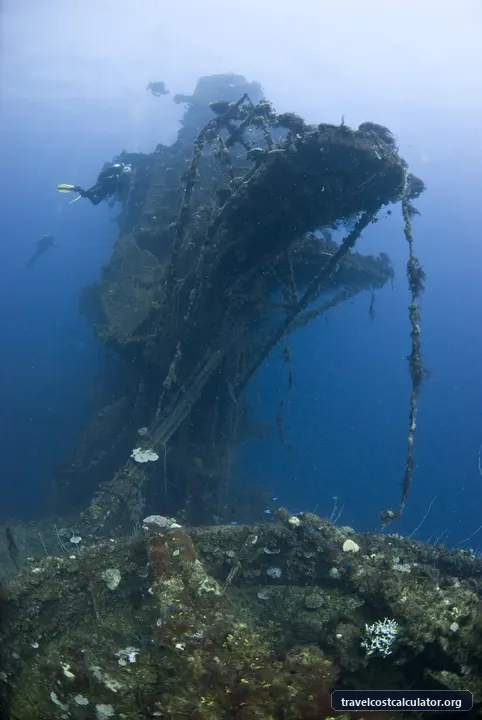
Today, Bikini Atoll remains a stark monument to human power and geopolitical displacement. The indigenous Bikinian population was relocated in 1946 with promises that they could return once tests were complete; however, lingering soil contamination (primarily Cesium-137) has rendered long-term terrestrial habitation impossible without ongoing remediation. Beneath the turquoise waters of the lagoon lies what is widely considered the absolute pinnacle of technical wreck diving: a submerged ghost fleet of target vessels, including the aircraft carrier USS Saratoga (CV-3), the Japanese battleship IJN Nagato (flagship of Admiral Yamamoto during the attack on Pearl Harbor), and numerous WWII destroyers, submarines, and attack craft.
🎟️ Entrance Fees, Opening Hours & Ticket Booking Tips
Bikini Atoll does not operate like a traditional national park with daily opening hours, turnstiles, or drop-in ticket windows. Access is strictly controlled by the Bikini Atoll Local Government (BALG) in coordination with the Marshall Islands Historic Preservation Office. Visitors can only access the site via licensed liveaboard charter vessels or approved scientific/documentary expeditions.
Estimated 2026 Permit & Package Costs
Because entry to Bikini Atoll is handled exclusively through authorized expedition operators, individual "ticket prices" are paid as administrative permits embedded into liveaboard charters or local council fees. All transactions in the Marshall Islands are processed in United States Dollars ($ USD).
-
✦
Bikini Atoll Government Entry & Diving Permit Fee: $450 – $550 USD per diver/visitor (payable through your authorized charter vessel operator).
-
✦
Marshall Islands Marine Resources Authority (MIMRA) Conservation Levy: $100 – $150 USD per person.
-
✦
Full 10-to-14-Day Liveaboard Expedition Cost (2026 Rates): $7,200 – $11,500 USD per person. This fee includes full-board accommodation at sea, technical diving permits, helium/oxygen mixes (for technical divers), dive guide services, and land excursions to key historic bunkers.
Booking Tips & Seasonal Availability
-
✦
Book 12 to 18 Months in Advance: Operating permits for liveaboard vessels are strictly capped by the island council to preserve the pristine marine eco-system and ghost fleet. Slots for 2026 and 2027 fill exceptionally fast.
-
✦
Dive Certification Requirements: If you intend to dive the submerged fleet, standard open-water certifications are insufficient. Most wreck decks sit at depths between 30 and 55 meters (100 to 180 feet). Operators mandate advanced technical diving credentials (such as TDI Extended Range, PADI Tec 50, or Rebreather/CCR certification) along with proof of minimum deep-water dive logs.
-
✦
Land-Only Visitors: Non-diver historical researchers must arrange private charter permits directly through the Bikini Atoll Local Government liaison office in Majuro Travel Budget.
🚌 How to Get There & Local Transit Costs
Reaching Bikini Atoll requires navigating one of the most remote travel corridors in the world. Travelers must first arrive in the capital city of Majuro before transferring via sea vessel or localized charter flight to the northern atolls.
Step 1: International Flight to Majuro (MAJ)
The primary gateway to the Marshall Islands is Amata Kabua International Airport (MAJ) in Majuro. In 2026, air access is primarily operated by United Airlines via its famous "Island Hopper" route (Flight UA154/155).
-
✦
From Honolulu (HNL) to Majuro (MAJ): $1,200 – $2,100 USD round-trip (approx. 5 hours direct flight time).
-
✦
From Guam (GUM) to Majuro (MAJ): $1,100 – $1,800 USD round-trip via Chuuk Travel Budget and Pohnpei.
Step 2: Transit from Majuro to Bikini Atoll
There are no scheduled commercial ferry lines or commercial airlines flying direct passenger flights to Bikini Atoll. You have two primary transport options:
-
✦
Expedition Liveaboard Ship (Most Common): Your expedition vessel will depart either directly from Majuro Harbor or from Kwajalein Atoll (Ebeye). The sea crossing from Majuro to Bikini Atoll takes approximately 24 to 36 hours across open ocean aboard specialized ocean-going vessels. Transit costs are included in your overall charter package.
-
✦
Charter Flights (Air Marshall Islands): Twin-engine propeller planes can be privately chartered through Air Marshall Islands from Majuro to the gravel landing strip on Bikini Island (BKI Airport). A round-trip group aircraft charter costs between $12,000 and $18,000 USD total, which is Split Travel Budget among expedition participants.
Local Transit Costs in Majuro (Stopover)
-
✦
Shared Airport Taxi: $5 – $10 USD per person to hotels in the D-U-D (Dalap-Uliga-Djarrit) urban area.
-
✦
Town Shared Taxis: $1.50 – $3.00 USD flat rate per ride along the main Majuro paved road.
📸 Best Photography Spots & Insider Visit Hacks
Capturing images at Bikini Atoll presents extraordinary opportunities for both underwater photojournalists and history enthusiasts. The lighting, deep underwater visibility (often exceeding 30 meters/100 feet), and pristine decay of WWII naval engineering make it unmatched.
Top Photography Locations
-
✦
USS Saratoga Flight Deck & Helldiver Aircraft: Sitting at a depth of 27 to 35 meters, the massive wood-and-steel flight deck of this 270-meter aircraft carrier offers iconic wide-angle opportunities. Below deck in the hangar bays, photo-divers can capture preserved Curtiss SB2C Helldiver airplanes with their cockpits intact.
-
✦
IJN Nagato's Inverted 16-Inch Guns: Resting upside down at 50 meters, the colossal main artillery barrels of Japan’s former flagship offer breathtaking scale shots when framed against blue oceanic light.
-
✦
Castle Bravo Crater Edge: Visible via aerial photography or low-altitude charter flights, the 2-kilometer-wide, 73-meter-deep blast crater remains an awe-inspiring, haunting scar carved into the northwest reef matrix of the atoll.
-
✦
Abandoned Nuclear Observation Bunkers: On land, thick reinforced-concrete observation bunkers covered in tropical creepers offer powerful terrestrial photo opportunities depicting nature reclaiming modern war infrastructure.
Insider Visit & Safety Hacks
-
✦
Understanding Radiation Safety: Water acts as an exceptional shield against residual radiation. Diving the wrecks poses zero radiation risk to human health. On land, ambient gamma radiation is low enough for safe short walking tours; however, do not consume local food products (coconuts, breadfruit, or land crabs), as soil-borne Cesium-137 remains active in terrestrial vegetation. Liveaboards supply all imported food and freshwater.
-
✦
Camera Equipment Care: Bring dual high-powered strobes or video lights for underwater photography, as depth absorbs warm color spectra quickly. Carry ample spare parts, O-rings, and silicone grease—there are no dive shops or camera repair centers within 500 nautical miles.
-
✦
Optimal Seasonal Weather: The best sea conditions occur during the dry season window from May through October, when trade winds diminish, creating glassy surface waters and maximum underwater clarity.
🏨 Nearby Accommodation & Daily Budget Allocation
There are currently no functional commercial hotels, resorts, or open land lodges operating on Bikini Atoll itself (the former basic land camp closed years ago). As a result, accommodation is split between your transit stopovers in Majuro and your onboard stay at sea.
Accommodation Options
-
✦
Expedition Liveaboard (At Bikini Atoll): Air-conditioned private or shared cabins onboard specialized dive charters (e.g., Master Liveaboards fleet). Inclusive of all meals, technical dive support, and onboard amenities.
-
✦
Hotel Robert Reimers (Majuro Stopover): A reliable, mid-range local hotel overlooking the lagoon. Rooms range from $120 – $170 USD per night.
-
✦
Marshall Islands Resort (Majuro Stopover): Features oceanfront rooms, a swimming pool, and an onsite restaurant. Rooms range from $145 – $210 USD per night.
Daily Budget Breakdown (Estimated 2026 Costs)
Planning a trip to Bikini Atoll requires high-tier budget allocation due to the technical nature and extreme remoteness of the trip. Below is an estimated daily breakdown:
-
✦
Low-End / DIY Traveler (Majuro Stopover Phase): $160 – $230 USD / day
- Budget hotel room (shared): $70 – $90
-
✦
Local dining & casual meals: $40 – $60
-
✦
Taxis & local museum fees: $15 – $30
-
✦
Miscellaneous: $35
- Liveaboard cabin & all gourmet meals: $450 – $750
A visit to the Bikini Atoll Nuclear Test Site is not merely a vacation—it is an extraordinary journey to one of humanity's most significant historical crossroads, where marine life flourishes amidst the sunken iron titans of the twentieth century.
Frequently Asked Questions
Essential visitor FAQs for Bikini Atoll Nuclear Test Site
What is the entrance fee for Bikini Atoll Nuclear Test Site?
How much time do you need to explore Bikini Atoll Nuclear Test Site?
How do I get to Bikini Atoll Nuclear Test Site from the nearest city?
📊 Heritage Quick Specs
Visiting Marshall Islands on a Budget?
Calculate your full daily travel budget for Marshall Islands — including hotel costs, local transport, food, and sightseeing expenses.
View Marshall Islands Daily Travel Costs →Explore more UNESCO World Heritage Sites
🏛️ All 1,200+ Heritage Sites →