
 Germany
Berlin Modernism Housing Estates
Berlin Modernism Housing Estates. The property consists of six housing estates that testify to innovative housing policies from 1910 to 1933, especially during the Weimar Republic, when the city of Berlin was p...
Berlin Modernism Housing Estates
🏛️ Overview & Historical Significance
In 2008, UNESCO inscribed the Berlin Travel Budget Modernism Housing Estates (Siedlungen der Berliner Moderne) onto the World Heritage list, recognizing a revolutionary architectural movement that fundamentally redefined urban living in the 20th century. Constructed between 1919 and 1933 during the Weimar Republic, these six residential housing developments rejected the dark, cramped, and unsanitary 19th-century tenement blocks (known as Mietskasernen) that previously dominated working-class Berlin. Instead, visionary architects transformed social housing into bright, airy, and human-centric living spaces.
Led by master urban planners and architects such as Bruno Taut, Martin Wagner, Walter Gropius, and Hans Scharoun, this housing movement applied the egalitarian principles of the Bauhaus and New Objectivity (Neues Bauen). The core philosophy was simple yet groundbreaking: every citizen, regardless of income, deserved access to Licht, Luft und Sonne (light, air, and sun), modern indoor plumbing, private green yards, and communal park spaces.
The UNESCO designation encompasses six distinct housing estates scattered across Berlin, each showcasing a unique response to modern urban challenges:
-
✦
Großsiedlung Britz (Hufeisensiedlung / Horseshoe Estate) – Neukölln: Designed by Bruno Taut and Martin Wagner (1925–1933), this is the most famous estate. Its centerpiece is a massive, 350-meter-long horseshoe-shaped building surrounding a natural pond, seamlessly blending curved modernism with community green spaces.
-
✦
Gartenstadt Falkenberg (Paintbox Estate / Tuschkastensiedlung) – Treptow-Köpenick: Built by Bruno Taut (1913–1916), this early garden-city development is celebrated for Taut's bold, vibrant exterior paint schemes—utilizing primary reds, blues, and ochres to turn housing facades into living canvas art.
-
✦
Siedlung Schillerpark – Wedding: Designed by Bruno Taut (1924–1930), this estate features dark exposed brickwork inspired by Dutch tradition and Frank Lloyd Wright, offering a robust, functionalist aesthetic centered around wide interior courtyards.
-
✦
Wohnstadt Carl Legien – Prenzlauer Berg: Designed by Bruno Taut and Franz Hillinger (1928–1930), this high-density urban estate utilizes colorful interior courtyards and recessed loggias to bring warm light into compact apartment layouts.
-
✦
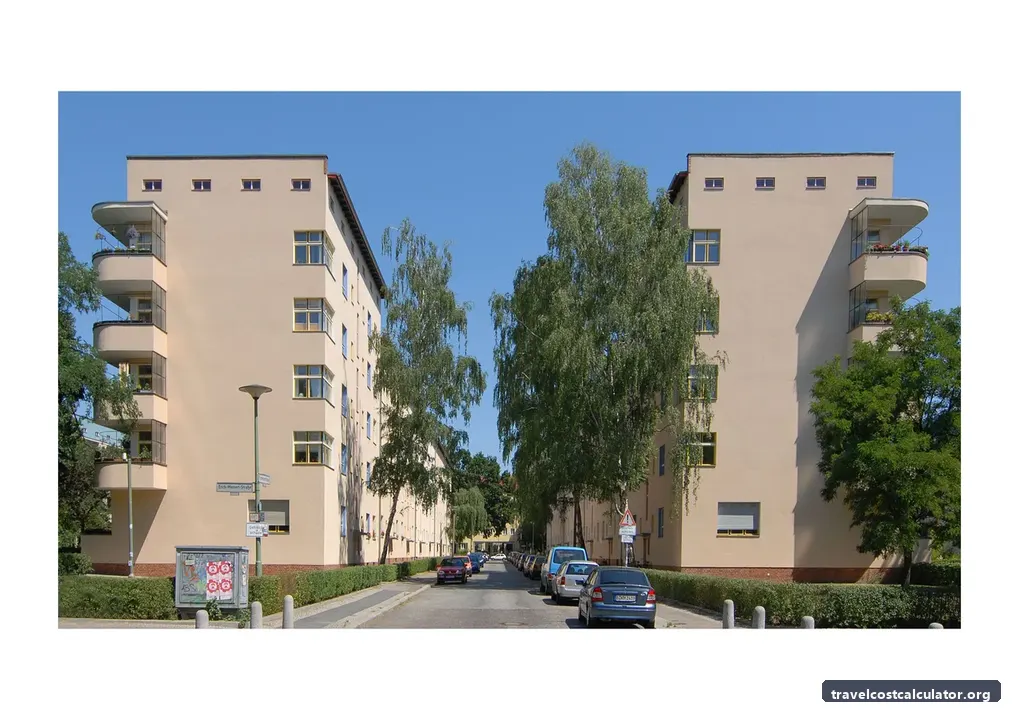
Weiße Stadt (White City) – Reinickendorf: Designed by Otto Rudolf Salvisberg, Bruno Ahrends, and Wilhelm Büning (1928–1931), this development represents high modernism with brilliant white facades, flat roofs, and iconic features like the cantilevered Brückenhaus (Bridge House) spanning Aroser Allee.
-
✦
Großsiedlung Siemensstadt (Ringsiedlung) – Spandau / Charlottenburg-Nord: Designed by a star-studded collective including Hans Scharoun and Walter Gropius (1929–1931), this estate features striking nautical-inspired architecture, complete with curved balcony rails resembling ocean liner decks.
🎟️ Entrance Fees, Opening Hours & Ticket Booking Tips
Because these World Heritage sites are active, lived-in residential neighborhoods, visiting the grounds, open courtyards, and streetscapes is completely free of charge (€0 / $0 USD) and accessible 24 hours a day, 365 days a year. However, to access indoor museum flats, visitor centers, or specialized guided architectural tours, modest fees apply.
2026 Estimated Visitor Costs
-
✦
Public Outdoor Access: Free (€0.00 / $0.00 USD) for all six estates.
-
✦
Info-Station Hufeisensiedlung (Britz Visitor Center & Small Exhibition): Entry fee is approximately €3.00 – €5.00 ($3.30 – $5.50 USD). Open limited days (typically Fridays and Sundays from 13:00 to 17:00).
-
✦
"Taut's Home" (Renting/Visiting the Restored 1920s Museum House): Special guided interior access to this fully restored Bruno Taut house costs approximately €12.00 – €15.00 ($13.20 – $16.50 USD) per person, available via advance booking only.
-
✦
Guided Architectural Walking Tours (2–3 Hours): Official group tours led by professional architectural historians average €18.00 – €28.00 ($19.80 – $30.80 USD) per person. Private customized tours start around €150.00 – €220.00 ($165.00 – $242.00 USD) per group.
Insider Booking & Visiting Tips
To maximize your budget and avoid disappointment, keep these strategic points in mind:
-
✦
Book Tours Early: Architectural walking tours organized by organizations like Ticket B or the Bauhaus Archive run on select weekends and fill up fast. Reserve your spot online 3 to 4 weeks prior to your visit.
-
✦
Respect Resident Privacy: Remember that these iconic buildings are home to thousands of Berliners. Stay on public footpaths, keep noise levels low, and refrain from photographing directly into private ground-floor windows or private back gardens.
-
✦
Utilize the Digital Guides: Download the free Bauhaus+ or official city architectural podcast tours onto your smartphone before setting out, providing expert commentary without the cost of a private guide.
🚌 How to Get There & Local Transit Costs
All six Berlin Modernism Housing Estates are conveniently connected to Berlin’s world-class public transport network operated by the BVG and S-Bahn Berlin. Most locations fall within Berlin Transit Zones A and B, with Gartenstadt Falkenberg sitting near the outer AB/C boundary.
Step-by-Step Directions to Key Estates from Central Berlin (Hauptbahnhof / Alexanderplatz)
-
✦
To Hufeisensiedlung (Britz): From Alexanderplatz, take the U-Bahn U7 toward Rudow and alight at U Blaschkoallee or U Lipschitzallee. Walk east for 5 minutes down Parchimer Allee. Transit time: ~22 minutes.
-
✦
To Wohnstadt Carl Legien (Prenzlauer Berg): Take the S-Bahn S41/S42 (Ringbahn) or S8 to S Prenzlauer Allee, or take the U2 to U Erich-Weinert-Straße. Transit time: ~15 minutes from Alexanderplatz.
-
✦
To Siedlung Schillerpark (Wedding): Board the U-Bahn U6 heading north toward Alt-Tegel and exit at U Rehberge. The estate is a 3-minute walk from the station exit. Transit time: ~14 minutes from Friedrichstraße.
-
✦
To Weiße Stadt (Reinickendorf): Take the U-Bahn U8 toward Wittenau and exit at U Paracelsus-Bad. Walk west onto Aroser Allee. Transit time: ~18 minutes from Alexanderplatz.
-
✦
To Großsiedlung Siemensstadt (Charlottenburg-Nord): Board the U-Bahn U7 toward Rathaus Spandau and exit at U Siemensdamm or U Zitadelle. Transit time: ~25 minutes from West Berlin (Zoologischer Garten).
-
✦
To Gartenstadt Falkenberg (Bohnsdorf): Take the S-Bahn S9 or S45 to S Grünau, then transfer to Bus 393 to Gartenstadt Falkenberg. Transit time: ~45 minutes from central Berlin.
2026 Public Transportation Ticket Options
-
✦
BVG Single Ticket (AB Zone): €3.50 ($3.85 USD) – Valid for 2 hours of travel in one direction.
-
✦
24-Hour Day Ticket (AB Zone): €9.80 ($10.80 USD) – Ideal if visiting 2 to 3 estates in a single day.
-
✦
Berlin WelcomeCard (72-Hour Pass): €36.00 ($39.60 USD) – Includes unlimited transit across Zones AB and discounts at nearby museums.
-
✦
Deutschlandticket (Monthly Pass): €58.00 ($63.80 USD) – If you are traveling extensively across Germany during your trip, this pass covers all regional trains, U-Bahns, S-Bahns, buses, and trams nationwide.
-
✦
Taxi / Rideshare (Uber/Bolt): Expect to pay €25.00 – €40.00 ($27.50 – $44.00 USD) for a taxi ride between distant estates (e.g., Siemensstadt in the west to Carl Legien in the east).
📸 Best Photography Spots & Insider Visit Hacks
Photographing the Berlin Modernism Housing Estates is a visual dream for lovers of clean geometry, primary colors, and dramatic shadow lines. Because the architecture relies heavily on natural light, timing your visit around sun angles is essential.
Prime Photography Locations
-
✦
The Horseshoe Curve (Hufeisensiedlung): Stand at the southern edge of the central pond along Hühünenpfad during the early morning. The calm water acts as a mirror, creating perfectly symmetrical reflections of Bruno Taut’s sweeping curved facade.
-
✦
Akazienhof (Gartenstadt Falkenberg): Visit in the mid-afternoon when sunlight hits the intensely painted red, yellow, and deep-blue townhouse facades. Taut designed these structures specifically to interact with natural sunlight throughout the day.
-
✦
The Brückenhaus (Weiße Stadt): Position yourself along Aroser Allee underneath the striking multi-story residential bridge that spans the street. Wide-angle lenses (16mm–24mm equivalent) capture the stark white geometric geometry against the blue sky.
-
✦
Ship-Deck Balconies at Siemensstadt (Ringsiedlung): Walk along Goebelstraße to photograph Hans Scharoun's nautical-inspired building blocks. The rounded, metal-railed balconies create stunning architectural shadows during the late afternoon golden hour.
Insider Hacks for a Flawless Visit
-
✦
Best Time of Year: Visit during late spring (May–June) or early autumn (September–October). During these months, lush trees frame the housing blocks without completely obscuring the facade details behind dense summer foliage.
-
✦
Optimal Time of Day: Early morning (08:00–11:00) offers soft lighting, fewer pedestrian distractions, and peaceful quiet across the residential yards.
-
✦
Cluster Your Route: Do not attempt to visit all six estates in one day unless you enjoy rushing. Group them geographically:
- Northern Route: Siedlung Schillerpark + Weiße Stadt + Großsiedlung Siemensstadt.
-
✦
Southern/Eastern Route: Hufeisensiedlung + Gartenstadt Falkenberg + Wohnstadt Carl Legien.
🏨 Nearby Accommodation & Daily Budget Allocation
Because the estates are spread throughout various residential neighborhoods of Berlin, staying in central or well-connected districts like Neukölln, Prenzlauer Berg, or Charlottenburg provides easy U-Bahn access to all six UNESCO locations.
Recommended Accommodations
-
✦
Budget Option (Hostels / Value Hotels): Grand Hostel Berlin Classic (Tempelhof/Kreuzberg) or Circus Hostel (Mitte/Prenzlauer Berg). Modern dorm beds cost €35 – €55 ($38 – $60 USD)/night; private budget rooms cost €85 – €115 ($93 – $126 USD)/night. Great transport links via U-Bahn.
-
✦
Mid-Range Option (Boutique Hotels): Hotel Indigo Berlin Centre Alexanderplatz or Michelberger Hotel (Warschauer Straße). Expect stylish design and convenient transit access for €130 – €190 ($143 – $209 USD)/night.
-
✦
Architectural Specialty Stay ("Taut's Home"): Book a stay directly inside a fully restored 1920s Taut-designed townhouse at the Hufeisensiedlung. Authentically furnished with period Weimar Republic decor, it costs approximately €180 – €260 ($198 – $286 USD)/night (requires booking months in advance).
Dining Near the Estates
-
✦
Local Neighborhood Dining: Grab authentic Berlin street food—like a classic Currywurst (€4.50 / $5.00 USD) or a Turkish Döner Kebab (€7.50 / $8.25 USD)—near transit stations such as U Blaschkoallee or U Rehberge.
-
✦
Sit-Down Cafes & Bistro Meals: Trendy independent cafes in Prenzlauer Berg (near Carl Legien) or Neukölln offer lunch sets and specialty coffee for €12.00 – €22.00 ($13.20 – $24.20 USD) per person.
2026 Daily Budget Breakdown (per person)
-
✦
Budget Backpacker: $65 – $95 USD (€60 – €86 EUR) per day
- Hostel Bed: $42 (€38)
-
✦
Public Transit 24h Pass: $11 (€10)
-
✦
Street Food & Supermarket Meals: $27 (€25)
-
✦
Self-guided UNESCO Walking Tours: $0 (€0)
- 3-Star Boutique Hotel (shared): $95 (€86)
- Taut's Home Stay or 4/5-Star Hotel: $240 (€218)
Frequently Asked Questions
Essential visitor FAQs for Berlin Modernism Housing Estates
What is the entrance fee for Berlin Modernism Housing Estates?
How much time do you need to explore Berlin Modernism Housing Estates?
How do I get to Berlin Modernism Housing Estates from the nearest city center?
📊 Heritage Quick Specs
Visiting Germany on a Budget?
Calculate your full daily travel budget for Germany — including hotel costs, local transport, food, and sightseeing expenses.
View Germany Daily Travel Costs →Explore more UNESCO World Heritage Sites
🏛️ All 1,200+ Heritage Sites →