
 Guatemala
Archaeological Park and Ruins of Quirigua
Inhabited since the 2nd century A.D., Quirigua had become during the reign of Cauac Sky (723–84) the capital of an autonomous and prosperous state.
Archaeological Park and Ruins of Quirigua
🏛️ Overview & Historical Significance
Nestled within the lush, tropical lowlands of the Motagua River valley in southeastern Guatemala, the Archaeological Park and Ruins of Quiriguá stands as one of the most intellectually intriguing and artistically profound centers of the ancient Maya civilization. Designated a UNESCO World Heritage site in 1981, Quiriguá is renowned worldwide for possessing the finest, most intricate stone carvings in Mesoamerica, including the tallest free-standing sculpted monuments ever erected in the New World.
Although Quiriguá was inhabited starting in the Early Classic period (around 200 AD), its defining historical moment occurred in 738 AD. For centuries, Quiriguá existed as a vassal state to the powerful neighboring kingdom of Copán (located just across the border in modern-day Honduras). However, Quiriguá's ambitious ruler, K'ak' Tiliw Chan Yopaat (also known as "Cauac Sky"), executed a daring military surprise attack, capturing and publicly decapitating Copán’s high king, Uaxaclajuun Ub'aah K'awiil ("18 Rabbit").
This seismic political shift granted Quiriguá immediate control over the crucial Motagua River trade routes—the primary artery for prized Maya commodities such as jadeite, obsidian, and quetzal feathers. Flush with unprecedented wealth and newly won independence, King Cauac Sky commissioned an aggressive building campaign, erecting colossal stelae and complex zoomorphic sculptures that surpassed those of his former liege in scale and detail.
UNESCO recognized Quiriguá because its monuments represent an unmatched pinnacle of Maya artistic evolution. The site's deep-relief carvings, hieroglyphic texts, and astronomical records—carved into soft, fine-grained reddish sandstone without metal tools—provide historians with critical chronologies of 8th-century Mesoamerican politics, mythology, and social hierarchy.
🎟️ Entrance Fees, Opening Hours & Ticket Booking Tips
Visiting Quiriguá remains one of the best-value historical experiences in Central America. Unlike heavily commercialized sites like Tikal Travel Budget, Quiriguá offers an intimate, uncrowded atmosphere where visitors can appreciate ancient craftsmanship without long lines.
-
✦
Foreign Visitor Entrance Fee: 100 GTQ (~$13.00 USD per person).
-
✦
Guatemalan Nationals Entrance Fee: 20 GTQ (~$2.60 USD, valid ID required).
-
✦
Children under 12: Free.
-
✦
Opening Hours: 8:00 AM to 5:00 PM, Monday through Sunday (365 days a year).
Crucial 2026 Ticket & Cash Tips:
There is currently no official online booking portal for Quiriguá tickets; entry passes must be purchased direct at the visitor kiosk at the park entrance. Cash in local currency (Guatemalan Quetzales - GTQ) is strictly required. Credit card readers at the remote park entrance are frequently offline or unavailable. Ensure you withdraw Quetzales in a larger city like Morales, Río Dulce, or Guatemala City Travel Budget before departing.
While formal advance reservations aren't necessary, international visitors must present a valid physical passport or clear digital copy at the ticket counter for identity registration. Hiring an official English or Spanish-speaking local guide at the entrance gate is highly recommended and costs approximately 150 GTQ to 200 GTQ (~$20 - $26 USD) per group for a fascinating 90-minute tour.
🚌 How to Get There & Local Transit Costs
Quiriguá is located in the Izabal Department, approximately 205 kilometers northeast of Guatemala City along the main Atlantic Highway (CA-9). It sits roughly halfway between the capital and the Caribbean coastal city of Puerto Barrios.
1. From Guatemala City (Budget & Express Bus)
Take the comfortable, air-conditioned Transportes Litegua long-distance bus from the main terminal in Guatemala City (Zone 1) heading toward Puerto Barrios. Request to be dropped off at the "Cruce de Quiriguá" (Quiriguá Junction at kilometer marker 205).
-
✦
Bus Fare: ~90 - 110 GTQ ($12 - $14 USD) one-way.
-
✦
Transit Time: Approximately 4 to 4.5 hours.
2. From Río Dulce or Morales
If you are basing yourself in the popular traveler hub of Río Dulce or nearby Morales, catch any southbound colectivo (shared minivan) traveling along the CA-9 toward Los Amates or Morales and ask for the Quiriguá junction.
-
✦
Colectivo Fare: ~20 - 30 GTQ ($2.50 - $4.00 USD) one-way.
-
✦
Transit Time: 45 minutes to 1 hour.
3. From the CA-9 Junction to the Archaeological Site Gate
Once dropped off at the highway junction (Cruce de Quiriguá), the actual park entrance sits 4 kilometers down a paved road lined with banana plantations. You have two primary local options:
-
✦
Tuk-Tuk / Local Microbús: Plentiful at the junction. A tuk-tuk ride direct to the park gate costs roughly 15 - 20 GTQ ($2 - $2.60 USD) per person.
-
✦
Private Taxi: Roundtrip taxi service negotiated at the junction (including 2 hours of wait time at the park) costs around 150 - 200 GTQ ($20 - $26 USD).
📸 Best Photography Spots & Insider Visit Hacks
Prime Photography Locations
-
✦
Stela E (The Colossus): Rising over 10.5 meters (35 feet) high and weighing over 65 tons, Stela E is the largest carved stone monolith in the ancient Maya world. It is so iconic that it is depicted on the Guatemalan 10-centavo coin. Frame your photo looking upward to capture the ruler’s majestic portrait and intricate headpiece.
-
✦
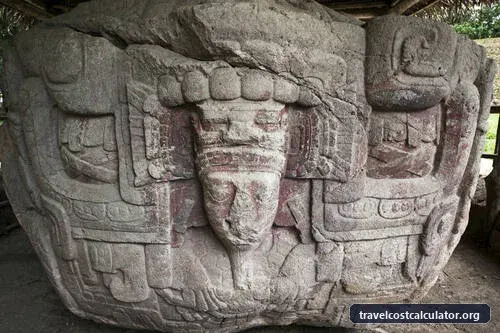
Zoomorph P (The Great Turtle): Located near the north end of the Acropolis, this massive 20-ton sculpted boulder depicts a cosmic mythic creature with human figures emerging from its jaws. The 3D high-relief carving details are best photographed from an angled perspective.
-
✦
The Great Plaza Viewpoint: Step back to the edge of the manicured, grass-covered Great Plaza to capture the sweeping landscape of giant stelae rising under protective palm-thatched shelters, framed by dense tropical forest.
-
✦
The Acropolis Steps: Climb the stone stairways of the elevated residential and ceremonial court to capture an elevated wide-angle view of the central complex.
Insider Visit Hacks for 2026
1. Beat the Midday Heat and Rain: Izabal is notoriously hot, humid, and rainy. Arrive right when the gates open at 8:00 AM. You will enjoy cooler morning temperatures, vibrant jungle acoustics, and the best natural lighting before harsh shadows fall.
2. Prepare for Thatch Roof Lighting: To preserve the fragile sandstone from erosion, all major stelae are housed beneath open-air, thatched palm shelters. This creates high contrast between sunlit surroundings and shaded stone. Photographers should set their camera/smartphone to HDR mode or use exposure compensation to retain detail in the shaded carvings.
3. Insect Protection is Mandatory: Due to proximity to the Motagua River and surrounding vegetation, mosquitoes and biting midges (sandflies) can be relentless. Bring high-strength insect repellent (DEET or Picaridin), wear lightweight long sleeves, and apply sunblock early.
🏨 Nearby Accommodation & Daily Budget Allocation
Because the park itself is relatively compact (requiring roughly 2 to 3 hours to explore thoroughly), most travelers visit Quiriguá as a day trip while staying in nearby towns like Morales, Río Dulce, or Puerto Barrios.
Recommended Places to Stay
-
✦
Budget (~$20 - $40 USD / night): Hotel Posada del Rey (Morales) – A clean, straightforward hotel located 25 minutes from the junction with air conditioning and reliable Wi-Fi.
-
✦
Mid-Range (~$70 - $130 USD / night): Hotel Mansión del Río (Río Dulce) – A scenic riverside resort located 1 hour away, offering pool amenities, water taxis, and on-site dining options.
-
✦
Eco-Lodge (~$50 - $90 USD / night): Hotel Hacienda Tijax (Río Dulce) – Nestled in a jungle rubber plantation with rustic wooden cabins, swimming facilities, and boat tours.
Estimated Daily Travel Budget (Per Person in 2026)
Below is a realistic breakdown of costs for visiting Quiriguá on a middle-of-the-road travel budget:
-
✦
Entrance Fee: 100 GTQ ($13 USD)
-
✦
Local Transportation (Roundtrip Colectivo + Tuk-tuk): 70 GTQ ($9 USD)
-
✦
Meals & Drinks: 120 GTQ ($15 USD) – Enjoy a traditional Plato Típico (stewed beef or chicken, black beans, fried plantains, fresh cheese, and warm corn tortillas) at local eateries.
-
✦
Mid-Range Accommodation (Shared Twin Rate): 350 GTQ ($45 USD)
-
✦
Incidentals & Water/Snacks: 40 GTQ ($5 USD)
-
✦
TOTAL DAILY BUDGET: ~$87 USD (approx. 680 GTQ)
Frequently Asked Questions
Essential visitor FAQs for Archaeological Park and Ruins of Quirigua
What is the entrance fee for Archaeological Park and Ruins of Quirigua?
How much time do you need to explore Archaeological Park and Ruins of Quirigua?
How do I get to Archaeological Park and Ruins of Quirigua from the nearest city?
📊 Heritage Quick Specs
Visiting Guatemala on a Budget?
Calculate your full daily travel budget for Guatemala — including hotel costs, local transport, food, and sightseeing expenses.
View Guatemala Daily Travel Costs →Explore more UNESCO World Heritage Sites
🏛️ All 1,200+ Heritage Sites →