
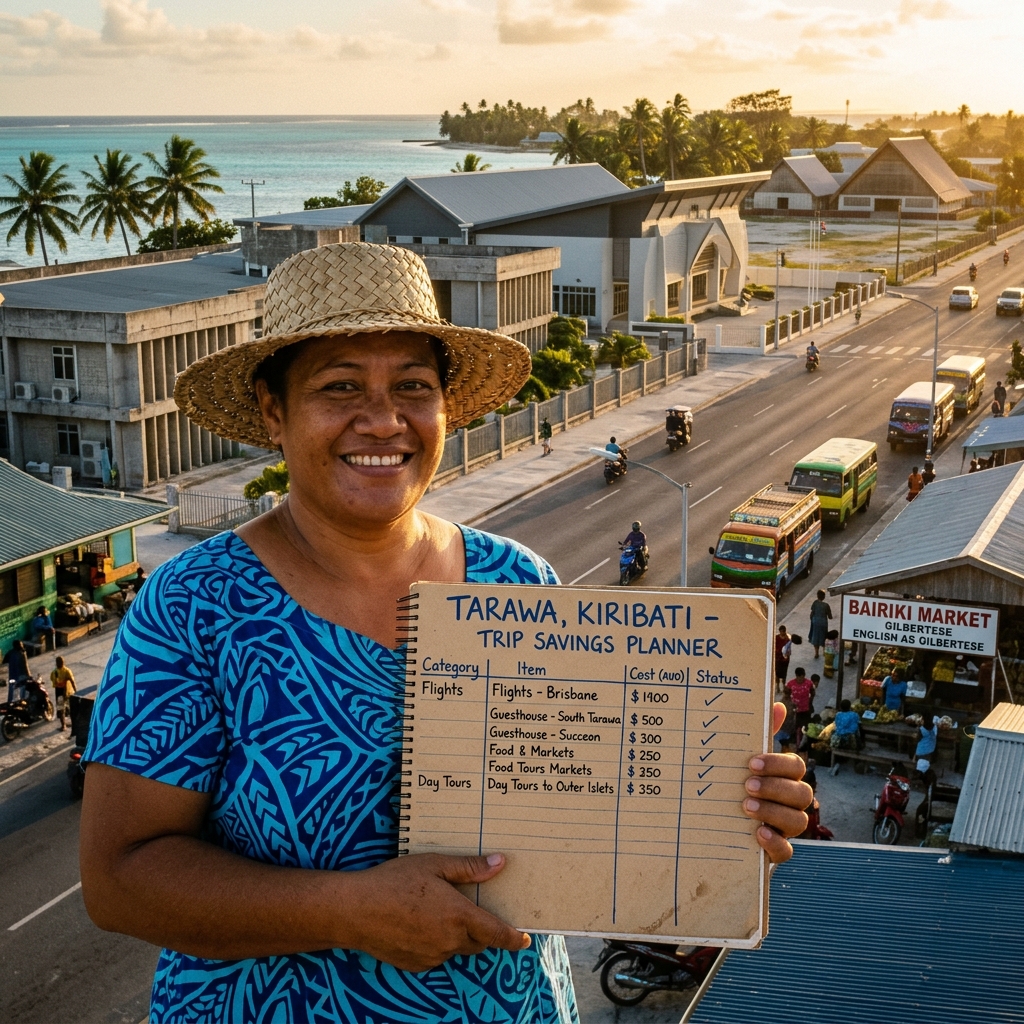
Few places on Earth offer the raw, untamed isolation of Tarawa Travel Budget, the capital atoll of the Republic of Kiribati. Stretched thinly across a vast ribbon of coral reef in the central Pacific, Tarawa is a mesmerizing destination where turquoise lagoons meet profound World War II history and authentic Micronesian culture. However, traveling to one of the most remote nations in the world requires calculated financial planning. In 2026, rising global transit costs and remote logistics mean that winging your budget simply isn't an option.
Whether your goal is to explore the battlegrounds of Betio, navigate the tranquil traditional villages of North Tarawa, or simply experience life on an atoll at the frontlines of climate resilience, this 2026 Tarawa Trip Savings Planner Planner provides exact cost projections, tier-by-tier breakdowns, and a concrete savings calendar to help you turn this bucket-list expedition into reality.
2026 Baseline Daily Financial Benchmarks for Tarawa
Because Kiribati imports almost all consumer goods, fuel, and packaged foods via container ship or air freight, daily operational costs differ significantly from mainland Southeast Asia or Central America. Kiribati uses the Australian Dollar (AUD) as its official currency, though all figures below are presented in USD for standardized financial planning.
- Backpacker Tier: Approximately $114 per day (Accommodation: $62/night, Food: $35/day, Local Transport: $17/day).
- Standard / Mid-Range Tier: Approximately $325 per day (Accommodation: $207/night, Food: $83/day, Local Transport: $35/day).
- Luxury / Executive Tier: Approximately $938 per day (Accommodation: $621/night, Food: $207/day, Local Transport: $110/day).
These benchmarks represent core daily on-island living expenses. International long-haul flights, outer-island excursions, travel insurance, and dedicated historical guides require separate allocation in your overall savings master plan.
Detailed Expense Breakdown: What Your Money Buys in 2026
1. Accommodation
Accommodation in South Tarawa ranges from rustic family-run guesthouses to standard business-style hotels frequented by NGO workers, diplomats, and marine researchers. In North Tarawa (accessible via small boat or causeway links), traditional thatched-roof kia-kia style eco-lodges dominate.
- Budget ($62/night): Clean, unpretentious local motels and traditional eco-guesthouses with basic fan cooling, shared or private cold-water bathrooms, and simple furnishings (e.g., community-run bungalows along South Tarawa or North Tarawa hideaways).
- Mid-Range ($207/night): Air-conditioned en-suite rooms in established South Tarawa properties (such as The George Hotel, Utirerei Hotel, or Fannikao Ecolodge) offering reliable backup generators, private bathrooms, desk space, and on-site dining.
- Luxury ($621/night): Premium ocean-facing executive suites, fully serviced self-contained chalets, or high-end catered lagoon compound buyouts that guarantee private transportation support, priority starlink/broadband connectivity, and full concierge support.
2. Food & Dining
Dining on Tarawa revolves heavily around the ocean's bounty—particularly yellowfin tuna, skipjack, and lagoon fish—paired with rice, taro, breadfruit, and pandanus fruit. Fresh vegetables are scarce and expensive due to atoll soil limitations, while imported canned goods and Australian staples line the shelves of local trade stores.
- Budget ($35/day): Dining at local roadside kaokioki stands, consuming fresh sashimi and rice bowls from Betio market vendors, snacking on fresh coconuts (moimoto), and cooking basic pantry staples in communal guesthouse kitchens.
- Mid-Range ($83/day): Enjoying sit-down meals at hotel restaurants and popular local Chinese establishments across Bairiki and Teaoraereke. A typical mid-range day includes a hot cooked breakfast, a fresh fish curry or chow mein for lunch, and a three-course seafood dinner with imported beer or Australian wine.
- Luxury ($207/day): Full à la carte dining across the island's premier hotel dining rooms, customized private seafood barbecues featuring spiny lobster and deep-sea reef fish, premium imported wines, and private chef services arranged through your lodge.
3. Transportation & Getting Around
South Tarawa consists of a single 30-kilometer paved road running from Betio in the west to Bonriki International Airport in the east. Moving efficiently between islets requires distinct transport choices.
- Budget ($17/day): Hopping on the ubiquitous, colorfully decorated shared minivans (buses) that travel the main paved road for around $1.00 to $1.50 per hop, combined with extensive walking and the occasional bicycle rental.
- Mid-Range ($35/day): Utilizing a mix of pre-arranged private taxis for airport transfers and evening dinners, combined with shared minivan travel for casual daytime exploration and small water taxi fares across the lagoon to North Tarawa.
- Luxury ($110/day): A dedicated private 4WD rental car with air conditioning or a private vehicle and driver on retainer for your entire stay, plus private chartered speedboat transfers across the lagoon to isolated outer islets.
4. Sightseeing, Tours, and Experiences
The island's primary tourism attractions involve WWII military history, marine exploration, and cultural immersion. Budget an additional sinking fund for activities:
- Betio WWII Guided Tour: Expect to pay $60 to $120 for an expert local historian to show you the massive coastal defense guns, bunkers, shipwrecks, and memorials from the 1943 Battle of Tarawa.
- North Tarawa Day Excursion: A boat trip to Abatao or Buota including traditional lunch, canoe paddling, and lagoon swimming costs roughly $75 to $150 per person.
- Traditional Fishing Charter: Half-day offshore fishing charters targeting tuna and wahoo range from $250 to $450 per boat.
The Big Ticket Item: Flight Budgeting for 2026
Getting to Tarawa accounts for the largest single percentage of your total trip outlay. Flights into Bonriki International Airport (TRW) operate only a few times per week via specific regional hubs:
- Via Nadi Travel Budget, Fiji (NAN): Operated by Fiji Airways (typically 2 flights weekly). Cost in 2026: $850 – $1,400 round-trip from Nadi.
- Via Brisbane, Australia (BNE) / Nauru (INU): Operated by Nauru Airlines on their Central Pacific corridor. Cost in 2026: $1,100 – $1,800 round-trip.
- Via Honiara, Solomon Islands (HIR): Regional connections via Solomon Airlines / Nauru Airlines partnerships: $900 – $1,500 round-trip.
Total Long-Haul Flight Reserve: North American or European travelers should budget between $1,800 and $2,800 total for round-trip flights spanning their home airport to Tarawa.
Sample Total 7-Day & 10-Day Trip Budgets (Excluding Long-Haul Airfare)
| Travel Tier | Daily Core Spend | 7-Day Stay (+ Activities) | 10-Day Stay (+ Activities) | Recommended Contingency Buffer |
|---|---|---|---|---|
| Backpacker | $114 / day | $950 | $1,340 | $200 |
| Mid-Range | $325 / day | $2,575 | $3,650 | $450 |
| Luxury | $938 / day | $7,160 | $10,180 | $1,000 |
The 2026 Step-by-Step Tarawa Savings Roadmap
Reaching an exotic remote destination requires structured savings discipline. Here is how to plan your monthly deposits based on an average 7-day mid-range expedition totaling approximately $4,800 (including long-haul flights of $2,000, 7 days on-island expenses of $2,575, and a $225 emergency reserve).
The 12-Month Sinking Fund (Most Comfortable)
- Monthly Target: $400.00 / month
- Weekly Target: $92.30 / week
- Daily Micro-Goal: $13.15 / day
- Execution Strategy: Automate an automatic transfer into a dedicated high-yield travel savings account on every payday. Reallocate discretionary funds from restaurant delivery and unused digital subscriptions.
The 6-Month Intensive Plan
- Monthly Target: $800.00 / month
- Weekly Target: $184.60 / week
- Daily Micro-Goal: $26.30 / day
- Execution Strategy: Combine a strict home-dining routine with a dedicated side-income stream (freelancing, overtime, or selling unused electronics and gear) to hit aggressive milestones quickly.
The 3-Month Fast Track
- Monthly Target: $1,600.00 / month
- Weekly Target: $369.20 / week
- Daily Micro-Goal: $52.60 / day
- Execution Strategy: Direct seasonal tax refunds, annual bonuses, or liquidated assets directly into your Tarawa expedition fund while running a bare-bones baseline budget.
Insider Money-Saving Tips for Tarawa in 2026
- Carry Sufficient Physical Cash (AUD): Credit card terminals in South Tarawa are prone to frequent satellite outages, and ATMs in Bairiki and Betio can run out of cash after flight arrivals or holiday weekends. Avoid emergency high-fee wire transfers by converting Australian Dollars before boarding your flight in Nadi or Brisbane.
- Embrace Local Minivans: South Tarawa’s mini-buses run continuously from dawn until late evening along the main causeway. Flag them down anywhere for a fraction of private taxi rates while enjoying local music and friendly conversations.
- Savor the Raw Tuna Economy: Fresh yellowfin tuna is often cheaper by weight than imported canned meat. Buying sashimi direct from fish stalls near the Betio docks delivers world-class protein at backpacker prices.
- Group Outer-Lagoon Charters: If heading to North Tarawa or chartering a boat to see the WWII shipwrecks in the lagoon, connect with fellow travelers or expatriates at hotels like The George or Utirerei to Split Travel Budget charter boat fuel costs.
Final Thoughts
Tarawa is an extraordinary travel destination that rewards intrepid travelers with rich history, legendary Polynesian-Micronesian hospitality, and an intimate encounter with a fragile oceanic ecosystem. While the logistics require upfront investment, disciplined execution of this 2026 savings plan ensures that financial stress won't distract you from the magic of the Kiribati atolls. Set your savings target today, secure your Pacific flight connections early, and prepare for an unforgettable journey.