
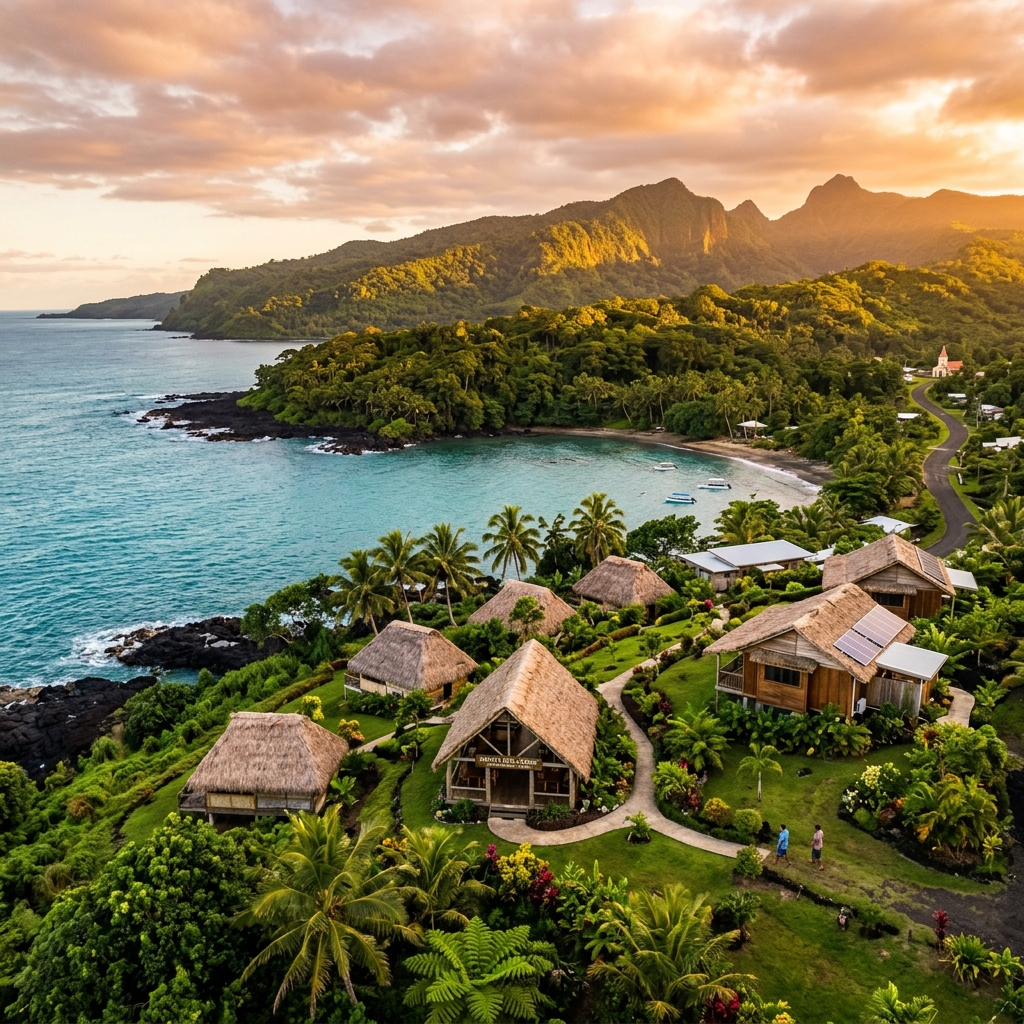
Introduction: Carbon Footprint Calculator Across Samoa's Big Island in 2026
Savai'i, the largest yet least populated island of Samoa, remains one of the South Pacific's most pristine destinations. Known locally as the "Cradle of Polynesia," Savai'i offers towering volcanic peaks, verdant rainforest reserves, and coastal blowholes untarnished by mass tourism. However, traveling to an isolated island in Polynesia inherently raises questions about environmental impact. As sustainable tourism becomes the standard in 2026, forward-thinking travelers are turning to a carbon footprint Travel Cost Calculator to assess and mitigate the ecological debt of their journey before setting foot on the sand.
Every journey to Savai'i generates carbon emissions, primarily driven by long-haul air travel and inter-island sea crossings. Fortunately, once you arrive on the island, Savai'i offers an extraordinary blueprint for low-carbon, community-based living. By choosing traditional beach fales that require zero air conditioning, dining on hyper-local staple foods harvested within village borders, and utilizing shared electric shuttles or colorful local buses, you can dramatically cut your daily carbon tonnage. This comprehensive 2026 guide breaks down the real financial costs of traveling through Savai'i across three distinct budget tiers, matching your fiscal budget with an environmentally conscious carbon plan.
Understanding Your Savai'i Carbon Footprint: A 2026 Analysis
When running your itinerary through a carbon footprint calculator, the emissions of a Savai'i vacation divide into two distinct categories: en route emissions and in-destination emissions.
1. Aviation & The Mulifanua–Salelologa Ferry
The vast majority (typically 80% to 90%) of your total trip emissions stem from the flights into Faleolo International Airport (APW) on the main island of Upolu. A direct flight from Auckland Travel Budget to Apia Travel Budget produces roughly 0.42 metric tons of CO2 equivalent per passenger, while a flight originating from the West Coast of North America or Europe easily exceeds 1.5 to 2.8 metric tons per passenger. From Upolu, travelers transfer to the Mulifanua Wharf to board the public ferry to Salelologa on Savai'i. The 90-minute crossing produces approximately 6 to 9 kg of CO2 per passenger—a fraction of the airborne footprint, but still an essential calculation metric.
2. Terrestrial Lodging and Energy Consumption
Samoa has accelerated its transition toward renewable energy, with solar installations and hydro power contributing significantly to the national grid in 2026. However, traditional concrete resorts with continuous Split Travel Budget-system air conditioning place heavy demands on local infrastructure. Conversely, booking a locally woven open-air fale (thatched bungalow) drops your accommodation-related emissions to near zero, utilizing offshore trade winds for natural cooling.
2026 Financial Tiers vs. Carbon Expenditure
One of the pleasant paradoxes of Savai'i travel is that low-carbon choices often correlate with lower financial costs. Below is a detailed breakdown of the three financial tiers for Savai'i in 2026, highlighting the environmental implications of each tier.
Backpacker / Low-Carbon Tier: ~$108 per day
- Accommodation: $59 per night (Open-air, beachfront traditional fale, fan-cooled, communal solar-assisted amenities)
- Food: $33 per day (Communal breakfasts and dinners included with fale stays; fresh papaya, taro, fresh tuna, coconut water)
- Transport: $16 per day (Wooden-seated public buses, shared minivans, or rented single-speed village bicycles)
- Estimated Daily Carbon Output: 8–15 kg CO2e per person
The backpacker tier provides the absolute lowest carbon output on the island. By staying in a village-run fale in Manase or Falealupo, your lodging footprint is negligible. Transport via the vibrant, timber-framed village buses running from Salelologa provides both cultural immersion and high-density, low-emission travel. Meals are generally prepared by the host family using traditional umu (earth oven) cooking methods, relying on zero imported, refrigerated shelf-stable goods.
Standard / Mid-Range Tier: ~$310 per day
- Accommodation: $198 per night (Enclosed beachfront bungalow or eco-lodge, partial solar air-conditioning or high-efficiency ceiling fans)
- Food: $79 per day (Mix of resort dining, village cafes, and beachside grills emphasizing local catch and organic produce)
- Transport: $33 per day (Occasional local taxi hire, shared hybrid tour vans, or multi-day electric scooter rentals)
- Estimated Daily Carbon Output: 25–45 kg CO2e per person
The standard tier balances personal comfort with environmental consideration. In 2026, mid-range eco-resorts along the northern coast feature closed architectural suites that employ inverter air conditioning units powered partly by on-site photovoltaic systems. Daily transport splits between public transport and low-emission scooters or shared transport services to remote sites like the Alofaaga Blowholes. Food selections broaden to include resort-style dining that mixes local organic sourcing with regional imports from New Zealand.
Luxury / High-Carbon Tier: ~$898 per day
- Accommodation: $594 per night (Private premium villa, 24/7 central climate control, private plunge pool)
- Food: $198 per day (Fine resort dining, imported wine lists, specialized international ingredients, private beach dinners)
- Transport: $106 per day (Private dedicated 4WD SUV rental or private chauffeured transfers for all island touring)
- Estimated Daily Carbon Output: 85–140 kg CO2e per person
Savai'i's top-tier luxury properties provide seclusion and bespoke service, but they come with a substantially higher carbon cost. Continuous air conditioning, private cold pools, fuel-heavy 4WD excursions across rugged volcanic terrain, and imported perishables flown into the country all drive up your carbon tally. If choosing this tier, purposeful carbon offsetting through certified marine and mangrove restoration funds in Samoa is highly recommended.
Detailed Spending Breakdown for Savai'i in 2026
Accommodations
A standard night in a traditional beach fale runs between $50 and $65, which almost universally includes a hearty breakfast and home-cooked dinner. Mid-range properties like boutique eco-resorts range from $180 to $220 per night, featuring ensuite private bathrooms, hot water heaters, and enclosed walls. High-end luxury villas and private coastal estates command upwards of $550 to $650 per night, offering high-draw electrical amenities and complete privacy.
Dining & Low-Food-Miles Nutrition
Consuming local food is one of the most effective ways to slash emissions on Savai'i. An imported burger and fries at a high-end marina cafe will run around $25–$35 and carries a heavy maritime shipping footprint. In contrast, purchasing fresh seasonal fruit (papaya, banana, starfruit) and warm keke pua'a (pork buns) from local roadside stalls costs under $6 per meal. For dinner, traditional dishes like oka (raw fish marinated in fresh coconut cream, lime, and chili) cost approximately $12–$18 at independent eateries, supporting small-scale artisanal fishermen using paddle outriggers rather than industrial commercial trawlers.
Sightseeing & Conservation Fees
Virtually all land on Savai'i is customary land owned by local villages. Expect to pay small entrance fees (custom fees) directly to village councils at natural landmarks:
- Alofaaga Blowholes: $5–$7 entry (Plus an optional $3 for village youths to toss coconuts into the surging vents)
- Falealupo Canopy Walkway: $8–$10 entry
- Saleaula Lava Fields: $5 entry (Exploring the ruins of the LMS church buried by Mt. Matavanu's 1905 eruption)
- Afu Aau Waterfall: $6 entry for freshwater swimming
These fees represent an exceptionally direct form of ecotourism revenue, channeling capital straight into local village governance and forest stewardship without intermediaries.
Actionable Tips to Minimize Your Savai'i Footprint
To keep both your financial ledger and carbon calculations low while discovering Savai'i in 2026, employ these field-tested practices:
- Favor Passive Cooling: Sleep in an open-air fale. Falling asleep to the rhythmic Pacific surf while trade winds circulate through woven blinds eliminates the 15–20 kWh daily electricity draw of a standard hotel A/C unit.
- Adopt Public Ferry Timetables: Avoid private motor launches between Upolu and Savai'i. Take the Samoa Shipping Corporation passenger ferry, which offers an energy-efficient crossing per capita.
- Carry a Gravity Water Filter: While tap water in resort areas is treated, village water systems vary. Carrying a durable UV or hollow-fiber purification bottle prevents the consumption of single-use plastic bottles, which often end up in island incinerators or landfills.
- Hire Local Walking Guides: When trekking up Mount Silisili or exploring the lava tubes, hire an accredited local village guide rather than an organized bus tour from Apia. This cuts transport fuel while keeping money inside the immediate community.
Conclusion
Visiting Savai'i in 2026 doesn't force a compromise between deep exploration and ecological integrity. By using a carbon footprint calculator to assess your long-haul transit and intentionally shifting toward locally anchored, low-emissions services on the ground, you can protect the very ecosystems that make Samoa extraordinary. Whether you spend $108 a day sleeping over the water in Manase or $898 relaxing in a luxury villa with verified carbon offsets, Savai'i remains a shining global example of how sustainable habits enrich travel.