
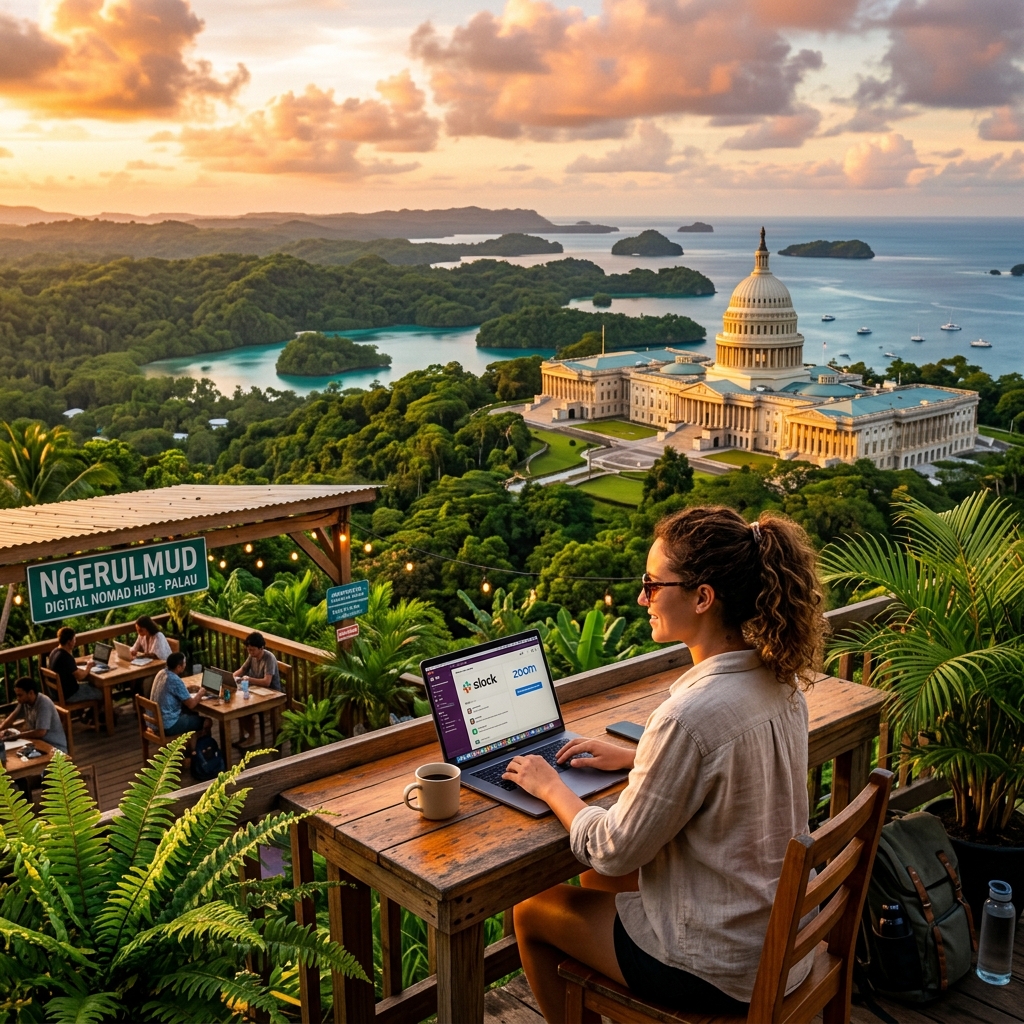
Introduction: Working Remotely from the World’s Most Unique Capital
Perched amidst the lush, rolling hills of Babeldaob Island, Ngerulmud Travel Budget holds the title of the world’s least populous national capital. Serving as the administrative seat of the Republic of Palau, Ngerulmud offers a remote work environment unlike any other Digital Nomad Living Index hub in Southeast Asia or the Pacific. Instead of crowded coworking cafes and relentless urban traffic, remote professionals working in and around Ngerulmud in 2026 are greeted by panoramic ocean breezes, neoclassical government architecture surrounded by dense jungle, and an unmatched sense of peaceful focus.
However, nomading in Palau requires meticulous financial planning and operational pragmatism. Because Ngerulmud is strictly an administrative complex within Melekeok State, long-term visitors typically base their accommodations across Babeldaob Island or in the adjacent commercial hub of Koror Travel Budget, commuting along the scenic coastal highway. In this 2026 guide, we break down the exact costs of living, connectivity requirements, visa regulations, and lifestyle expectations using our Nomad Travel Cost Calculator benchmarks.
2026 Cost of Living Breakdown for Digital Nomads
Palau uses the United States Dollar (USD) as its official currency. Because the nation relies heavily on maritime imports for consumer goods, fuel, and packaged groceries, day-to-day living costs sit higher than traditional nomad hubs like Bali or Chiang Mai. Here is a clear breakdown of daily and monthly expectations across three distinct lifestyle tiers.
Nomad Budget Tiers at a Glance
- Backpacker / Budget Nomad: Total estimated daily spend: $114/day.
- Accommodation: $62/night (Local guesthouses, shared island homestays, or modest studio rentals near Airai/Melekeok).
- Food & Drinks: $35/day (Self-catering from local markets, bento boxes, and neighborhood diners).
- Local Transport: $17/day (Shared rides, scooter rentals, or carpooling arrangements).
- Standard / Mid-Range Remote Professional: Total estimated daily spend: $325/day.
- Accommodation: $207/night (Private island bungalow, fully serviced ocean-view apartment, or modern hotel room with reliable AC and generator backup).
- Food & Drinks: $83/day (Mix of cafe breakfasts, seaside seafood lunches, and casual dining).
- Local Transport: $35/day (Dedicated compact rental car—essential for daily transit across Babeldaob).
- Luxury / Executive Nomad: Total estimated daily spend: $938/day.
- Accommodation: $621/night (High-end eco-resort villa or luxury waterfront suite with dedicated workspace).
- Food & Drinks: $207/day (Fine dining, private culinary services, imported premium wines, and resort bistros).
- Local Transport: $110/day (Premium 4x4 SUV rental or private chauffeured transfers).
Monthly Living Expenses & Budgeting Strategies
If you plan to base yourself near Ngerulmud for a full month (30 days), your financial blueprint will look roughly as follows depending on your comfort requirements:
Estimated 30-Day Monthly Nomad Budgets (2026)
- Budget Nomad: Approximately $3,420 / month. Suitable for solo freelancers willing to prepare their own meals, stay in simple local housing, and use economical transportation.
- Mid-Range Nomad: Approximately $9,750 / month. The sweet spot for established tech workers, consultants, and remote entrepreneurs requiring private vehicles, reliable high-speed broadband, and private comfortable housing.
- Executive Nomad: Approximately $28,140 / month. Full-service luxury with premium hospitality, oceanfront villas, top-tier diving expeditions, and private logistics.
Internet Speed, Connectivity, and Remote Work Logistics
Historically, remote work in Micronesia was hindered by latency and bandwidth limits. By 2026, Palau’s connectivity infrastructure has seen transformative upgrades thanks to enhanced subsea fiber connections and widespread satellite coverage across Babeldaob.
Wi-Fi & Data Infrastructure
While Ngerulmud itself does not have dedicated public commercial coworking facilities, many government buildings, cafes along the highway, and upscale lodgings provide robust connectivity. Here is what you need to prepare:
- Palau National Communications Corporation (PNCC): The national telecom provider offers 4G/LTE mobile data packages and eSIMs. A monthly 4G data bucket with 20GB–50GB typically ranges between $40 and $80.
- Satellite Internet (Low Earth Orbit): Many boutique resorts and guesthouses on Babeldaob utilize high-speed satellite terminals in 2026, delivering download speeds between 100 Mbps and 220 Mbps, making Zoom, asynchronous software development, and cloud computing perfectly smooth.
- Power Reliability: Tropical weather occasionally affects localized grid power on Babeldaob. Ensure your chosen lodging is equipped with automatic generator backups and carry heavy-duty power banks (65W+ PD) for your laptop and mobile devices.
Where to Live: Accommodation Strategies for Ngerulmud
Because Ngerulmud is purely a government complex containing the National Capitol building (the Olbiil Era Kelulau), executive offices, and judicial courts, you cannot sleep directly inside the administrative center. Nomads choose between three geographic strategies:
1. Melekeok Village (Closest Proximity)
Located just 5 to 10 minutes from Ngerulmud, Melekeok offers a tranquil, authentic Palauan coastal lifestyle. Accommodations here consist of beachfront guesthouses, private home sublets, and small eco-lodges. It is ideal for nomads who want total immersion in nature and deep focus without distractions.
2. Airai State (Midway Convenience)
Situated at the southern tip of Babeldaob Island, Airai is home to the Roman Tmetuchl International Airport (ROR) and connects directly to Koror via the Japan-Palau Friendship Bridge. Staying in Airai gives you a 30-minute commute to Ngerulmud along smooth, paved roads while keeping you close to shopping centers and Koror's dining scene.
3. Koror Commercial Hub (Urban Convenience)
Many nomads choose to sleep in Koror, where the bulk of short-term apartments, hotels, grocery supermarkets, dive shops, and cafes are situated. The commute from downtown Koror to Ngerulmud takes approximately 35 to 45 minutes along the well-maintained Compact Road.
Getting Around: Island Transportation in 2026
Public transportation in Palau is virtually non-existent for daily nomad work routines. Having your own wheels is non-negotiable if you plan to travel between Ngerulmud, your accommodation, and local spots.
- Compact Car Rentals: Renting a compact sedan costs around $35 to $45 per day (or $800 to $1,100 per month on negotiated medium-term contracts). Gas prices on the island hover around $5.20 to $5.80 per gallon in 2026.
- Scooters & Small Motorbikes: Available for $17 to $25 per day. While scenic on dry days, Babeldaob experiences frequent tropical rain showers, making an enclosed rental car the preferred option for remote workers carrying expensive electronics.
- Taxis: Taxis are unmetered and require phone dispatch. Trips between Koror and Ngerulmud can run upwards of $50 to $70 one-way, making full-time car rental vastly more economical.
Visas, Entry Requirements, and Legalities in 2026
Entering Palau as a remote worker requires understanding standard immigration and environmental regulations:
- 30-Day Tourist Visa on Arrival: Citizens of the United States, EU member states, the UK, Canada, Australia, Japan, and many other nations receive a free 30-day visa on arrival. Citizens of the US, Federated States of Micronesia, and Marshall Islands enjoy extended entry privileges under the Compact of Free Association.
- Visa Extensions: You can extend your 30-day tourist entry twice at the Bureau of Immigration in Koror for a nominal fee (approx. $50 per 30-day extension), allowing a total legal stay of up to 90 days.
- Pristine Paradise Environmental Fee (PPEF): Built into incoming international flight tickets (typically $100), this fee supports conservation efforts across the Palau National Marine Sanctuary.
- The Palau Pledge: Upon arrival, your passport will be stamped with the world-famous Palau Pledge, an eco-agreement you must sign promising to act with environmental mindfulness during your stay.
Lifestyle, Work-Life Balance, and Weekend Activities
Choosing Ngerulmud and Babeldaob as your remote workstation means trading busy nightlife for raw oceanic adventure. When your work shift ends, Palau offers some of the planet's most pristine marine ecosystems:
- World-Class Diving & Snorkeling: Explore the legendary Blue Corner, German Channel, and the Rock Islands Travel Budget Southern Lagoon (a UNESCO World Heritage Site).
- Hiking & Waterfalls: Visit the Ngardmau Waterfall on Babeldaob, trek to ancient stone monoliths (Badrulchau), and explore untouched coastal mangroves.
- Zero Traffic & Clean Air: Babeldaob’s Compact Road is virtually empty, allowing stress-free scenic drives between work sessions.
Pro-Tips for Nomads Heading to Ngerulmud in 2026
- Bring US Cash: While cards are accepted at major resorts and Koror supermarkets, smaller roadside fruit stands and village eateries on Babeldaob only accept physical cash.
- Secure Dual SIMs: Combine a local PNCC physical SIM card with an international roaming eSIM to ensure uninterrupted internet connectivity during storms.
- Pack Waterproof Dry Bags: Heavy tropical downpours are common; protect your laptop and electronics while commuting across the island.
- Respect Cultural Customs: When visiting villages outside the government complex in Ngerulmud, dress modestly (cover shoulders and knees) and ask permission before photographing local cultural sites.