
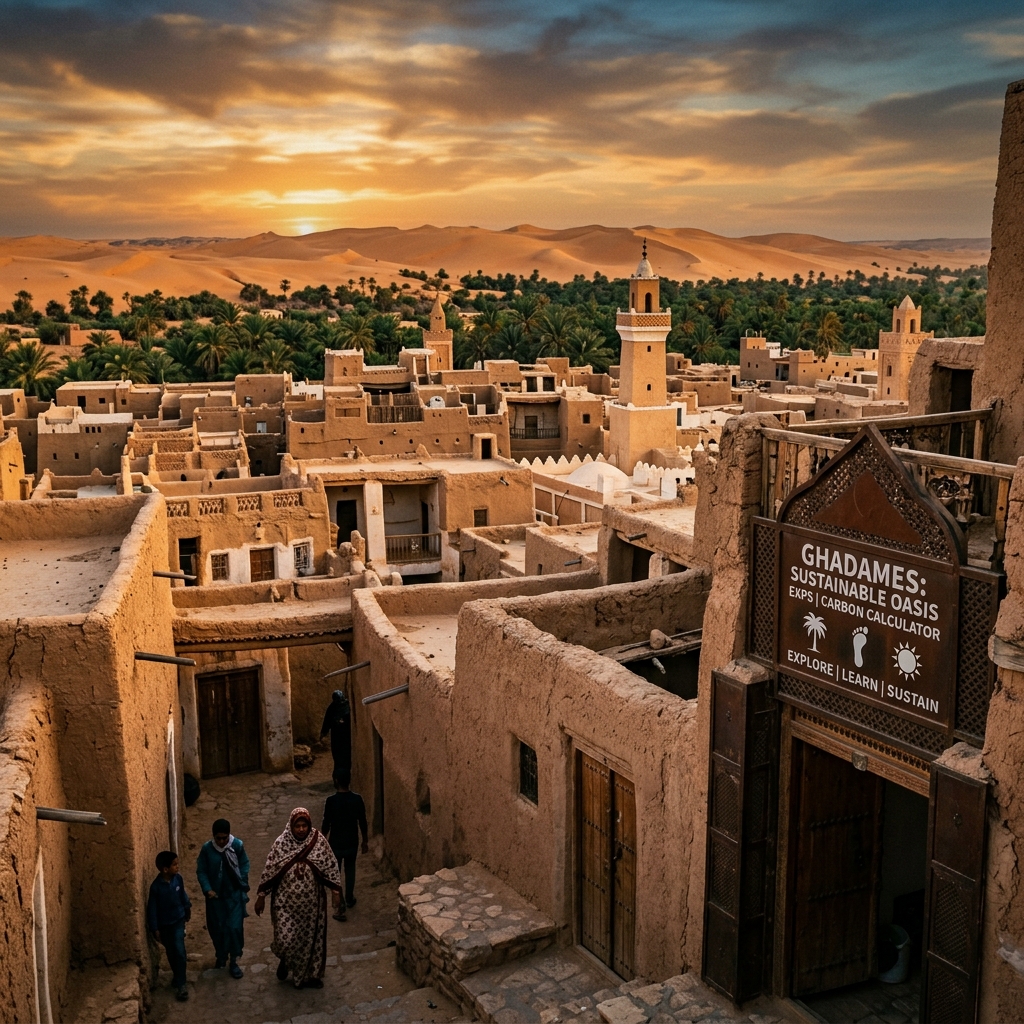
Ghadames Travel Budget in 2026: Balancing Desert Exploration with Carbon Consciousness
Known as the "Pearl of the Desert," the ancient oasis city of Ghadames, Libya, stands as one of the world’s most remarkable examples of climate-resilient vernacular architecture. Located at the historic crossroads of trans-Saharan trade routes near the borders of Algeria and Tunisia, this UNESCO World Heritage site features multi-tiered, lime-washed mud-brick dwellings designed centuries ago for natural cooling in extreme desert climates. As travel to southwestern Libya continues to reopen through specialized tour operators in 2026, balancing the complex logistics and environmental impact of reaching this remote desert outpost requires thoughtful planning.
Reaching deep into the Sahara presents significant logistical and ecological footprints. A comprehensive travel plan to Ghadames must pair detailed budget projections with precise carbon accounting. By using an integrated Carbon Footprint Calculator Travel Cost Calculator alongside your financial budget, you can measure the emissions generated by flights into Tripoli Travel Budget" class="text-primary font-bold">Tripoli Travel Budget, long-haul desert 4x4 convoys, and off-grid desert camps, ensuring your 2026 journey leaves a positive economic mark on local communities while offsetting your travel footprint.
Understanding Your Carbon Footprint for a Ghadames Expedition
Visiting Ghadames is not a standard city break; it is an expedition across 600 kilometers of the arid Hamada al-Hamra desert plateau from Tripoli. Calculating your environmental impact involves three distinct operational categories:
1. Aviation Emissions (Inbound to Tripoli)
International travelers in 2026 generally fly into Tripoli’s Mitiga International Airport (MJI) or Tripoli International Airport (TIP). A round-trip flight from major European hubs (such as Rome, Istanbul, or Tunis) generates an average of 0.35 to 0.75 metric tons of CO2 equivalent (CO2e) per passenger in economy class. Long-haul travelers originating from North America or Asia can expect emissions between 1.8 and 3.2 metric tons of CO2e.
2. Overland Transit & Convoy Emissions
The overland route from Tripoli to Ghadames covers approximately 1,200 to 1,300 kilometers round-trip. Because travel regulations in 2026 require registered tourist convoys with reliable four-wheel-drive vehicles (such as diesel Toyota Land Cruisers):
- Per-Vehicle Diesel Consumption: An average 4x4 expedition vehicle consumes roughly 12 to 14 liters of diesel per 100 km, producing approximately 380 to 420 kg of CO2e per round trip.
- Per-Passenger Allocation: When shared among 3 to 4 passengers, overland transit contributes roughly 95 to 140 kg of CO2e per person.
3. Local Oasis Footprint & Passive Living
Once inside the historic mud-brick city of Ghadames, your daily carbon emissions drop dramatically. The covered, labyrinthine alleyways provide natural shade, and traditional dwellings maintain internal temperatures around 20°C to 24°C without active air conditioning. Daily on-site operational emissions (meals, local walking tours, municipal solar/generator power) average just 8 to 15 kg of CO2e per traveler per day.
Daily Travel Budget Tiers for Ghadames (2026 Benchmarks)
Travel in Libya requires authorized local tour agencies to arrange mandatory security clearances, tourist visas, and licensed guides. While all visitors must travel through organized arrangements, independent-minded travelers can choose between modest guesthouses, standard cultural packages, or bespoke luxury expeditions.
| Budget Tier | Daily Accommodation | Daily Food & Drink | Daily Local Transport | Est. Total Daily Base |
|---|---|---|---|---|
| Backpacker / Budget | $20 / night | $11 / day | $5 / day | $36 / day |
| Standard / Mid-Range | $66 / night | $26 / day | $11 / day | $103 / day |
| Luxury / Expedition Tier | $198 / night | $66 / day | $35 / day | $299 / day |
Note: Base tiers exclude private 4x4 charter costs from Tripoli, mandatory tour company overheads, visa issuance fees, and long-range logistics.
Detailed Expense Breakdown for 2026
Accommodation
Accommodations in Ghadames range from community-run homestays inside the palm groves to restored traditional houses and modern hotels on the periphery of the old town:
- Traditional Mud-Brick Homestays & Hostels ($18 – $25/night): Shared rooms or floor mattresses in restored family compounds. These properties utilize thick clay walls and rooftop terraces for natural climate control, making them the lowest-carbon lodging option.
- Mid-Range Guesthouses & Oasis Hotels ($55 – $75/night): Comfortable private rooms featuring private bathrooms, basic air conditioning, hot water, and breakfast included (such as Ghadames Tourist Hotel or Winzrik Hotel when operational).
- Bespoke Desert Lodges & Private Heritage Suites ($180 – $220/night): Fully restored architectural mansions inside the old town or private luxury desert glamping setups positioned at the edge of the Grand Erg Oriental dunes.
Food, Dining & Local Cuisine
The culinary landscape of Ghadames relies heavily on oasis agricultural produce, dates, grains, and traditional Libyan staples:
- Street Food & Meal Cost Index & Local Eateries ($8 – $14/day): Fresh khubz (flatbread), shakshuka, chickpea soups, falafel, and strong Libyan mint tea brewed over open charcoal.
- Traditional Oasis Feasts ($20 – $30/day): Hearty platters of bazin (unleavened barley dough served with rich tomato, meat, and pumpkin stew), desert-spiced couscous, camel meat kebabs, and locally harvested deglet nour dates.
- Full-Service Expedition Catering ($55 – $75/day): Multi-course meals prepared by private camp chefs during sunset dune excursions, featuring roasted meats, fresh salads, bottled mineral water, and artisan tea ceremonies.
Transportation & Expedition Transfers
Navigating the distance between Tripoli and Ghadames requires understanding your transport emissions and expenses:
- Group Expedition 4x4 Seat ($40 – $70/day per person): Booking a seat in a shared 4x4 convoy arranged through a licensed agency. This splits fuel consumption across passengers, directly reducing your per-capita carbon footprint.
- Private Dedicated 4x4 Vehicle ($150 – $250/day total vehicle cost): Ideal for photography teams or independent parties desiring custom stops in Nalut and the Jebel Nafusa mountains.
- Within Ghadames ($0 – $10/day): The UNESCO Old Town is entirely pedestrianized. Motorized vehicles cannot enter the narrow, covered streets, so your intra-city transport footprint is practically zero.
Sightseeing, Permits & Cultural Guiding
Entry fees and local guidance ensure heritage preservation in Ghadames:
- Mandatory Local Old Town Guide ($25 – $40 per half-day): Local Ghadamsee guides are required to navigate the seven historic clan quarters, explain the intricate canal water-clock distribution system, and provide access to family museum houses.
- Ras al-Ghoul & Grand Erg Dune Excursion ($30 – $60 per person): Sunset excursions to the towering red sand dunes near the border tripoint where Libya, Algeria, and Tunisia converge.
- Libyan Tourism Clearance & Escort Permits ($150 – $300 per trip flat fee): State ministry fees and mandatory agency processing costs for desert travel permits in 2026.
How to Calculate and Offset Your Ghadames Carbon Footprint
Because desert ecosystems are vulnerable to climatic shifts, responsible travelers in 2026 should calculate their full journey emissions using a certified carbon calculator before departure. Follow these steps to audit your journey:
- Calculate Total Flight Mileage: Input your departure airport and Tripoli (MJI) into the calculator tool. Note the total flight CO2e.
- Add 1,300 km of Overland Driving: Input 1,300 km of standard SUV/Diesel 4x4 transit. For a vehicle carrying 3 passengers, add approximately 130 kg of CO2e per person.
- Factor Oasis Daily Operations: Add 12 kg of CO2e per day for your duration in Ghadames.
- Select High-Impact Offsetting Projects: Channel offset funds into verified projects (such as Gold Standard or VCS programs) dedicated to North African renewable energy deployment, Saharan afforestation (Great Green Wall initiatives), or arid water conservation.
Low-Carbon Travel Tips for the Libyan Desert
- Stay Inside the Old Town: Choose traditional guesthouses instead of modern concrete hotels on the highway. Mud-brick structures do not rely on energy-intensive cooling units.
- Pack Light to Reduce Aircraft Fuel Burn: Keep luggage under 15 kg; lighter gear directly decreases fuel consumption on both flights and 4x4 desert traverses.
- Avoid Single-Use Plastics: Tap water in desert oases is mineral-heavy; carry a UV purifier or sub-micron water filtration bottle to minimize plastic bottle waste in a municipality with limited recycling infrastructure.
- Support Local Cooperatives: Purchase date syrup, handwoven palm-leaf baskets, and Tuareg silver jewelry directly from artisan workshops inside the old town market.