
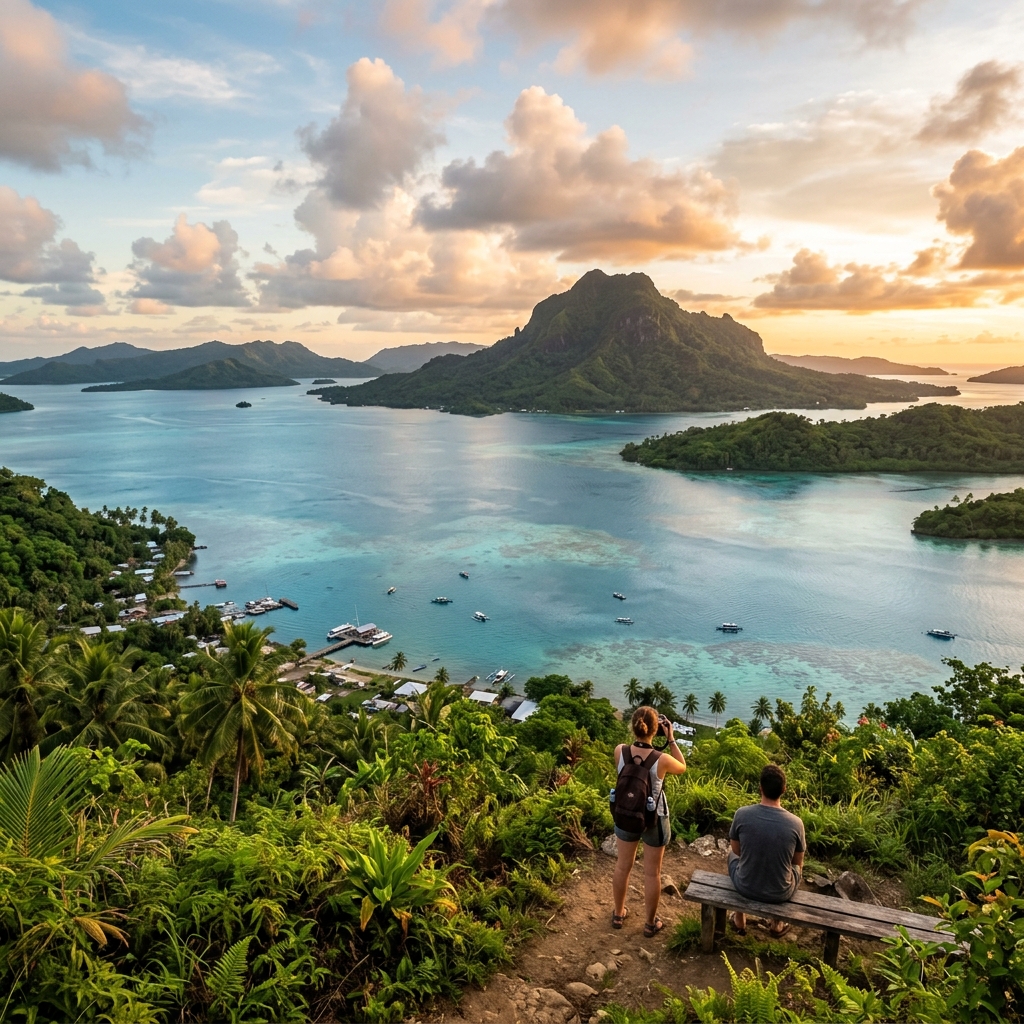
Rising quietly out of the deep turquoise expanse of the Western Pacific Ocean, Chuuk Travel Budget State (formerly known as Truk) in the Federated States of Micronesia (FSM) is legendary among world travelers and scuba divers. Home to the famous Chuuk Lagoon—the resting place of over 50 sunken Japanese warships, aircraft, and submarines from Operation Hailstone in 1944—this remote archipelago offers an extraordinary trip back in time. However, organizing a trip to this isolated corner of Micronesia is neither cheap nor straightforward.
Because Chuuk is thousands of miles from major continental hubs, entry logistics involve far more than just booking a hotel and clearing local customs. A successful, cost-effective journey requires understanding complex transit visa rules across US territories, navigating island-hopping airline routes, and budgeting for localized island pricing. This comprehensive travel guide details the exact entry hacks, visa rules, flight maneuvers, and real-world costs you need to plan an unforgettable adventure to Chuuk without breaking the bank.
Chuuk & FSM Visa Requirements Checker: Rules, Exemptions, and Entry Hacks
The Federated States of Micronesia maintains a welcoming visa policy for international tourists, but its strict passport validity rules and entry procedures catch many unprepared travelers off guard. Understanding these regulations before booking non-refundable flights is essential.
FSM Entry Policies by Country
The FSM does not issue physical tourist visas in advance for most nationalities. Instead, entry permits are granted upon arrival at Chuuk International Airport (TKK):
- United States Citizens: Under the Compact of Free Association (COFA), US citizens enjoy unlimited entry and residence rights in the FSM. You can enter with a valid US passport and stay indefinitely without a visa.
- Citizens of Schengen Area Countries: Travelers holding passports from Schengen member states can enter visa-free for up to 90 days within any 180-day period.
- Citizens of Australia, Canada, Japan, the UK, South Korea, and New Zealand: Passport holders from these nations receive an entry permit valid for up to 30 days upon arrival.
- Other Foreign Nationalities: Visitors from non-exempt nations must secure an FSM Entry Permit from the Division of Immigration in Pohnpei prior to travel.
The 120-Day Passport Rule (Crucial Entry Pitfall)
One of the most frequent reasons travelers are denied boarding at departure airports is failing the FSM's passport validity check. The FSM immigration authority mandates that your passport must be valid for at least 120 days (4 months) beyond your intended date of departure from Chuuk. Standard 6-month rules usually cover this, but if your passport has less than four months left, airlines will reject your check-in, even if your return flight is only a few days later.
Documentary Requirements Upon Arrival
To clear customs in Weno (Chuuk's administrative hub), you must present:
- A valid passport meeting the 120-day validity window.
- Proof of onward or return travel (an confirmed airline ticket leaving FSM).
- Proof of sufficient financial funds to sustain your stay.
- A completed FSM Health and Immigration Declaration Form (distributed on the plane).
The Ultimate "Visa Hack": Navigating the Guam Transit Trap
The single biggest logistical mistake travelers make when visiting Chuuk involves transit rules, specifically passing through Guam (GUM) or Honolulu (HNL). Almost all commercial flights into Chuuk International Airport are operated by United Airlines, frequently via their famed "Island Hopper" (UA 154 / 155) route or direct connections out of Guam.
Why You Need a US Visa / ESTA Just to Transit
Guam is an unincorporated territory of the United States. Unlike many international airports in Asia or Europe, US airports do not have "sterile international transit zones." Every single passenger arriving in Guam—even those staying on the exact same plane to continue to Chuuk—must disembark, pass through US Customs and Border Protection (CBP), and clear security.
This means your eligibility to transit through Guam dictates whether you can reach Chuuk:
- Visa Waiver Program (VWP) Passport Holders: Citizens of the UK, EU nations, Australia, Japan, South Korea, and other VWP countries MUST obtain an approved ESTA (Electronic System for Travel Authorization) online at least 72 hours before departure. Cost: $21 USD. Without an approved ESTA, your airline will deny boarding at your origin point.
- Non-VWP Passport Holders: Travelers from countries like India, China, the Philippines, or South American nations must hold a valid US B1/B2 Tourist Visa or a C-1 Transit Visa to transit through Guam. Getting a standard FSM entry permit is useless if you cannot legally transit Guam or Honolulu!
Transit Hack: Alternate Routing Options
If obtaining a US visa or ESTA is impossible or cost-prohibitive, your options to reach Chuuk are extremely limited. Historically, occasional charter flights or regional connections operate out of Manila Travel Budget or Tokyo, but United Airlines via Guam remains the primary scheduled lifeline. Always secure your US transit credentials before spending money on Chuuk dive packages or non-refundable resort deposits.
Comprehensive Budget Breakdown for Chuuk, Micronesia
Chuuk operates entirely on the US Dollar ($ USD). Because almost all consumer goods, fuel, food, and dive equipment must be shipped to Weno by boat or cargo plane, overall costs are significantly higher than in Southeast Asian diving hotspots like Indonesia or the Philippines. However, with smart planning, you can manage your trip expenses effectively.
Daily Travel Cost Summary Tiers
- Shoestring / Independent Budget: $140 – $180 per day (Limited land tours, budget accommodation, dining at local diners, minimal diving).
- Mid-Range Traveler / Eco-Tourist: $260 – $390 per day (Standard air-conditioned hotel, rented vehicle, mixed local/hotel dining, occasional dives).
- Dedicated Wreck Diver / Resort Guest: $480 – $800+ per day (Resort lodging, full-day boat charters, 2-3 tank daily dives, gear rental, fine resort dining).
1. Accommodation Costs
Accommodation options on Weno and the surrounding islands are limited. There are no traditional backpacker hostels, so budget travelers should look for small guesthouses or simple hotels.
- Budget Guesthouses / Basic Motels: $85 – $120 per night for simple double rooms with basic amenities.
- Mid-Range Dive Resorts (e.g., Truk Stop Hotel, Blue Lagoon Resort): $145 – $260 per night. These properties feature private docks, dive shops, air-conditioned rooms, and waterfront dining.
- All-Inclusive Liveaboard Vessels (e.g., Pacific Master, Truk Odyssey): $3,200 – $4,800 per week-long dive expedition. While high up-front, this includes all meals, accommodation, unlimited diving, and guide services.
2. Food, Beverage & Daily Dining Costs
Fresh local seafood (tuna, mahi-mahi, skipjack) and staples like taro, breadfruit, and rice are reasonably priced. However, imported packaged items, dairy, and meats carry heavy freight surcharges.
- Local Diners & Bakery Meals: $7 – $14 per person for local fish plates, fried chicken, or lunch boxes.
- Hotel & Resort Restaurants: Breakfast runs $10 – $18; lunch and dinner main courses range from $18 – $38 (steaks, fresh sashimi, pasta, burgers).
- Groceries & Snacks: Expect to pay $4.50 for a gallon of bottled water, $6.00 for imported snacks, and $4 – $7 for local canned beverages or beers.
- Daily Food Budget Recommendation: Allocate $45 to $80 per day if eating at hotels, or $25 to $40 per day if sticking to local markets and small lunch counters.
3. Local Transportation Costs
Getting around Weno requires understanding local transport dynamics. Roads can be rough, and public transport is informal.
- Shared Island Taxis: Shared mini-buses and sedans run continuously along Weno's main road. Short trips cost $1.50 – $3.00 per ride.
- Private Airport Transfers: Hotels usually provide airport pick-ups for $10 – $20 per person roundtrip.
- Rental Cars: Renting a sedan or 4WD vehicle costs roughly $55 – $80 per day (excluding fuel). This is ideal for exploring WWII Japanese battery installations on land.
- Boat Transfers to Outer Islands: Small skiff charters to outer islands (e.g., Tonoas, Fefan, Fonomu) cost between $90 and $220 roundtrip, depending on fuel prices and group size.
4. Diving, Excursions, and Mandatory Permits
Diving is the primary draw for visiting Chuuk Lagoon. The dive operations are professional, but specialized marine logistics incur specific costs.
- Chuuk Lagoon Dive Permit (Mandatory): All divers must purchase an official Chuuk State Dive Permit. Cost: $50 USD (valid for 1 year). This tax directly supports local marine conservation.
- Two-Tank Boat Dive Package: $160 – $230 per day (includes dive guide, boat, tanks, and weights).
- Dive Equipment Rental: Full set (BCD, regulator, wetsuit, mask, fins) runs $40 – $60 per day. Rental dive computers cost $15 – $20/day.
- Land WWII Historic Tours: Local landowners charge modest entry fees ($5 – $10 USD) to access historical Japanese military command centers, anti-aircraft guns, and lighthouse ruins scattered across the islands. Guide fees run around $40 – $70 per group for a half-day tour.
Pro Financial & Logistics Hacks for Chuuk
1. Bypassing Flight Hyper-Inflation with Airline Miles
Cash fares on United Airlines to Chuuk (TKK) frequently reach $2,000 to $3,500 roundtrip due to the carrier's route monopoly. Travel Hack: Redemptions via United MileagePlus or Star Alliance partner programs (like Air Canada Aeroplan or Singapore Travel Budget Airlines KrisFlyer) offer incredible value. A saver level award seat can often be booked for 27,500 to 45,000 miles each way, saving thousands of dollars in cash.
2. The Cash Economy Reality
While major dive resorts accept primary credit cards (Visa/Mastercard), they frequently charge a 3% to 5% processing surcharge. Furthermore, ATMs on Weno are limited, frequently run out of cash, or experience network downtime during power outages. Always carry enough cash (in $10, $20, and $50 USD bills) to pay for local taxis, tip dive crews, purchase land tour permits, and settle small restaurant bills.
3. Extending Your Stay Legally
If you fall in love with the island and want to stay beyond your initial 30-day entry permit (for non-US/Schengen citizens), visit the Division of Immigration office in Weno at least 7 days before your permit expires. You can request an extension of stay for up to 60 total days for a nominal administrative fee (typically $10 – $20 USD), provided you present proof of sufficient funds and updated flight bookings.
4. Beware the Departure Tax
Chuuk State assesses an airport departure tax of $20 USD per person upon departure. While some international flight tickets bundle this tax into the final fare, airline implementations vary. Keep a crisp $20 bill inside your passport sleeve at all times so you aren't caught off guard at the airport security desk.